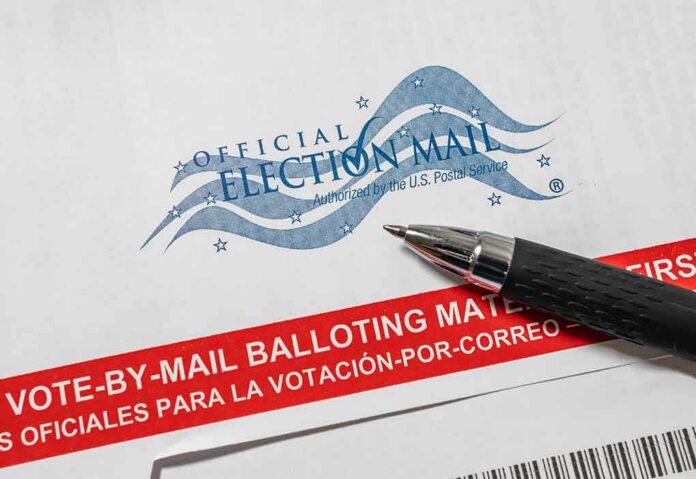
North Carolina began sending out mail ballots on Friday, making it the first state in the country to start voting in the 2026 midterm elections, even as President Trump’s administration fights in court to limit how those ballots work.
Quick Take
- North Carolina’s 100 county election boards started mailing absentee ballots on September 4, kicking off the 2026 general election voting period.
- The mailing comes amid an active legal battle over the Trump administration’s push to restrict mail voting nationwide.
- Some state officials say Postal Service changes are causing more mailed ballots to get rejected.
- Mail voting has grown steadily for decades and is now a routine part of how Americans cast ballots.
North Carolina Kicks Off the Midterm Voting Calendar
North Carolina’s state election board confirmed that county officials began mailing absentee ballots on Friday, September 4, to voters who had already requested one. State officials called it the formal start of voting in the 2026 general election, a milestone set by state law rather than any special announcement. The mailing covers voters across all 100 counties statewide.
North Carolina’s early start isn’t new. State election calendars have set this same September mailing date for past cycles, and other counties across the state, from Mecklenburg to Chatham, confirmed the identical rollout on their own local election pages. Early in-person voting will follow on October 15, giving voters two separate paths to cast a ballot before Election Day in November.
A Legal Fight Hangs Over the Ballots
The mailing started while a legal battle plays out over President Trump’s effort to impose new limits on mail voting before millions of Americans cast ballots this fall. Courts have not settled the dispute, and the rules governing mail ballots remain unresolved even as ballots go out the door. That timing means voters are filling out ballots under a cloud of legal uncertainty about which rules will ultimately apply.
Adding to the uncertainty, some state officials say changes at the Postal Service have led to more mailed ballots getting rejected, a concern raised alongside the ongoing court fight. This has fueled worry on both sides of the aisle that federal mail delivery changes could complicate an election process that depends heavily on ballots arriving and being returned on time.
Mail Voting Has Deep Roots, But Access Rules Keep Shifting
Mail and absentee voting is not some new experiment. It has expanded steadily since the 1980s, becoming a standard feature of American elections rather than a rare exception. Research from the Massachusetts Institute of Technology’s Election Lab shows this shift happened gradually over decades, well before the pandemic pushed mail voting into the national spotlight.
Even so, access to mail and early voting remains a political flashpoint. North Carolina’s state election board, controlled by a Republican majority, recently approved county voting plans that eliminate Sunday early voting everywhere except one county, a decision that drew criticism from Democrats. Polling also shows Republicans and Democrats continue to see voting access very differently, with support for early and absentee voting varying sharply by education and party.
North Carolina begins the first phase of mail-in voting for this year's midterm elections today, Friday, as election boards in the state's 100 counties begin mailing absentee ballots to voters who have requested them.
North Carolina is the first state in the US to begin voting…
— Saad Abedine (@SaadAbedine) September 4, 2026
What Comes Next for Voters
North Carolina voters who requested absentee ballots must return them by Election Day, while the deadline to request a mail ballot falls on October 20. Early in-person voting runs from October 15 through October 31. Other states will follow North Carolina’s lead in the coming weeks, rolling out their own mail ballots as the midterm calendar moves toward November.
For many Americans, this moment underscores a familiar frustration: basic election mechanics, like when ballots get mailed, have become entangled in Washington’s larger political fights. Voters on the left worry about access being restricted, while voters on the right raise concerns about mail voting’s security. Both camps are watching a legal fight neither expected to still be unresolved as ballots reach mailboxes.
Sources:
insiderpaper.com, ncsbe.gov, theguardian.com, chathamcountync.gov, ncforwardparty.com