

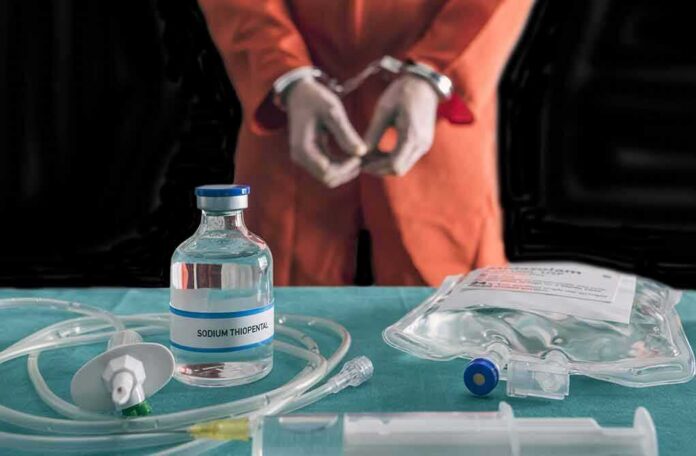
Amid a failed execution, Tennessee’s own records and courtroom filings point to repeated IV troubles that staff feared “might be blowing,” raising urgent questions about basic competence and state accountability.
Story Snapshot
- Attorney declaration says staff used about 10 needles and struggled to get IV access.
- Team members reportedly warned a vein “might be blowing” before drugs were pushed.
- Saline reportedly met resistance, hinting at a faulty line before drug delivery.
- State says it followed protocol and the drug is reliable but offers no detailed account.
What Pike’s Lawyers Say Happened Inside the Chamber
Attorney Randy Spivey filed a sworn declaration describing repeated failed attempts to place intravenous lines in both of Christa Pike’s arms. He wrote that the team went through about 10 needles before proceeding with the lethal drug. That account says staff struggled with access across several sites, which is a known weak point in many lethal injections. Spivey’s filing is the most detailed description now public, but it is not a state log or a medical chart.
The declaration recounts that at 6:57 p.m., one team member said a vein “might be blowing,” and another said, “it’s either blood or blown, I need to know.” That language signals doubt about whether the catheter was in the vein. Spivey also says the team had trouble pushing saline through the final line, which suggests a blockage or a misplaced catheter. These details, if accurate, point to a line that may not have been patent before drugs were administered.
The State’s Position and What We Still Do Not Know
The Tennessee Department of Correction said it followed every step of the state’s lawful execution protocol and that the lethal-injection drug has been consistently effective. The agency also said the protocol did not allow further procedures beyond what was done that night. Officials have not released a detailed explanation of what failed in this case, and they have not provided a public, technical account that addresses the reported IV problems.
There is no independent execution-team log, medical chart, or toxicology report in the public record that confirms exactly where the drug went or how much entered the bloodstream. The absence of those documents leaves key questions open: whether a vein truly ruptured, whether drug pooled in tissue, and how those factors tied to Pike’s clinical course after the attempt. Those answers require records the state has not yet shared publicly.
How This Fits a National Pattern of IV Failures
Documented lethal-injection problems in the United States often involve hard-to-find veins, limited training, and uncertain drug delivery. Encyclopaedia Britannica reports that more than seven percent of lethal-injection executions saw problems in one study of over 1,000 cases, with venous access issues common. These cases are not new or rare; they reflect systemic weaknesses when teams cannot place reliable lines but push ahead with a time-sensitive, high-stakes procedure.
Pike’s attorneys previously warned that her small veins and a blood condition could complicate access. A special master dismissed those pre-execution risk claims after hearing expert testimony, but that ruling addressed predictions, not the actual events. After the failed attempt, reporters noted that state officials still had not provided a technical explanation of what went wrong, while outside experts focused on whether an IV failure caused drug to enter tissue instead of blood.
Why This Matters for Both Sides of the Death-Penalty Debate
People who support the death penalty expect the government to carry it out competently, lawfully, and without unnecessary suffering. People who oppose it see execution failures as proof the system is broken and secretive. Both groups can agree on this: when the state takes a life, the process must meet the highest medical and ethical standards, and the public must see clear records that show what happened and why.
Protocol compliance is not the same as proof of proper drug delivery. If the catheter was not in the vein, the protocol’s checklists would not change the medical facts. The state’s next steps should be simple: release the execution-room notes, IV-attempt records, drug volumes, and any monitoring data. If the lines worked, those records will show it. If the lines failed, the public deserves an honest accounting and durable fixes before any future attempt.
Sources:
washingtontimes.com, apnews.com, cbc.ca, union-bulletin.com, reuters.com, guelph.ctvnews.ca