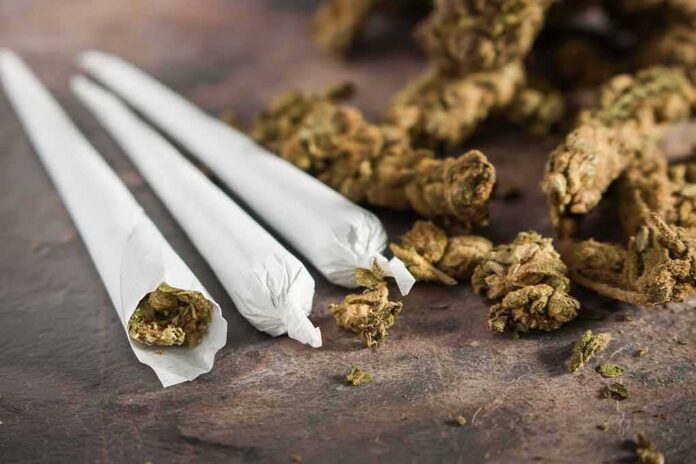
Daily cannabis use among U.S. parents has quadrupled since 2012, and now far outpaces daily alcohol use, a national study finds.
Story Highlights
- Daily parent cannabis use rose from 1.3% in 2012 to 5.2% in 2024
- Parents were about four times more likely to use cannabis daily than alcohol in 2024
- Use on most days climbed to 8.0% among parents living with children
- An estimated 5.9 million children live with a parent who uses most days
What the new study measured and why it matters
Researchers analyzed a large national survey and found that daily cannabis use among parents rose from 1.3% in 2012 to 5.2% in 2024, a fourfold jump. The team drew on the National Survey on Drug Use and Health, which collected hundreds of thousands of responses over that period. The same study reports that in 2024, parents were about four times more likely to use cannabis daily than to drink alcohol daily, a comparison of frequency, not potency or harm.
The study also tracked parents who used on most days, not only every day. That share rose from 2.6% in 2012 to 8.0% in 2024 among parents living with children. News coverage based on the study estimated that at least 5.9 million children live with a parent who uses marijuana on most days. These figures describe how common use is, not whether a child was present at the time of use or physically exposed to smoke or vapor.
How legalization and parental history may shape teen behavior
Separate research suggests policy and family history can interact. A 2024 longitudinal study pooling three intergenerational samples found that recreational legalization was linked to higher teen cannabis use for youth whose parents had used cannabis during their own adolescence. That link did not appear for teens whose parents lacked that history. This points to a channel where changing laws meet family patterns, which can raise concerns for both conservative and liberal parents about norms at home and in the community.
Broader reviews show mixed links to family outcomes. One systematic review concluded that legalization tends to increase parental cannabis use and approval. Yet, apart from accidental exposures in young children, the review found unclear evidence that legalization by itself worsens parenting or child outcomes. Another national analysis reported no increase in child maltreatment reports after recreational legalization, and even found declines in physical abuse reports, though results varied by measure.
What these numbers do—and do not—tell us about children
The headline increase signals a real shift in adult behavior. But the numbers do not tell us when parents use, whether they are impaired while caring for children, or what children actually breathe. One parenting-context study using real-time reports found that parents said children were present during use in a small share of episodes, while most use happened when children were absent. The main study relied on self-reported surveys, which can include recall or reporting error, but the trend is consistent across years.
Daily cannabis use among American parents is about four times as common as daily alcohol use, according to a new study. Researchers estimate at least 5.9 million children live with a parent who uses cannabis on most days.
Parental marijuana use rose substantially between 2012… pic.twitter.com/1113cEhJ0J
— Fox News (@FoxNews) October 22, 2026
Parents and policymakers across the spectrum share core worries: safety in the home, honest health messaging, and whether powerful interests profit while families sort out the risks. The evidence supports two ideas at once. Frequent parental cannabis use is rising and more common than daily alcohol use. Yet harm depends on timing, dose, and context. Clear rules at home, safe storage to prevent child access, and open talks with teens about expectations remain practical steps while researchers fill the evidence gaps.
Sources:
facebook.com, pmc.ncbi.nlm.nih.gov, infobae.com, tandfonline.com, onlinelibrary.wiley.com, it-boltwise.de