
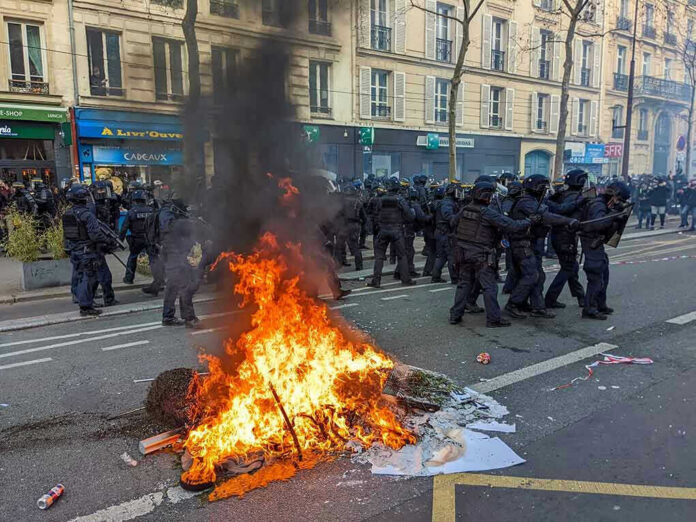
Paris police imposed a targeted nighttime curfew and protest ban after a weekend of mass arrests and injured officers from violent unrest.
Story Snapshot
- Police set a limited curfew and protest ban in select Paris areas for Monday night.
- Officials tied the move to looting and clashes after nationwide protests.
- President Emmanuel Macron said peaceful protesters must be distinguished from rioters.
- The government avoided a nationwide emergency and kept measures time-bound.
Police Order: Limited Curfew And Protest Ban In Key Paris Zones
The Paris police prefecture announced a curfew from 11:00 p.m. Monday to 6:00 a.m. Tuesday in several neighborhoods. The order also banned demonstrations in specific areas from 8:00 p.m. to 6:00 a.m. Police said the action aimed to protect people and property after looting and street violence near major sites, including Place de la République and the Les Halles district. Officials stressed the restrictions were narrow in scope and time, not a citywide shutdown of Paris.
Authorities tied the restrictions to a sharp public order crisis that intensified over the weekend. The Interior Ministry reported thousands of arrests across France and many injured police and gendarmes as clashes spread in multiple cities. National outlets also described damaged shops, smashed windows, and confrontations with riot police in parts of central Paris. The prefecture’s order framed the curfew and protest ban as tools to calm hotspots while regular patrols handled the rest of the city.
Stated Rationale: Protect People And Property, Avoid Blanket Measures
Police justified the order as a direct response to violence and looting risks in the named zones. The written aim, they said, was to shield residents, businesses, and public buildings from further harm during overnight hours when crowds are harder to manage. President Emmanuel Macron supported a targeted approach. He publicly urged officials to separate peaceful protesters with “legitimate demands” from those who “destroyed, smashed, and looted” and to ban demonstrations where needed to prevent more damage.
Top leaders rejected a sweeping emergency regime. The prime minister said curfews would be partial and tailored to the situation, and he ruled out a blanket curfew for all of Paris. Reporting emphasized that the government did not declare a state of emergency. Instead, it opted for short, local restrictions while reinforcing deployments to protect known flashpoints and commercial zones. This approach mirrors prior French practice during acute unrest: use time-limited orders focused on specific threats.
Scale Of Unrest: Arrests, Injured Officers, And Nighttime Risks
National figures underscored the scale of the crisis. Reporting cited 2,397 arrests and 997 injured police and gendarmes after a day of widespread clashes. Coverage also showed looting and damage in shopping areas and key squares in Paris. While the totals were national, they framed the government’s argument for sharp, local controls in places that saw the worst late-night crowds and property attacks. Earlier tallies put arrests around 1,200 and injured officers at 150 as the situation evolved.
Paris imposes nighttime curfew and protest ban after violent unrest #Paris #Macron #FranceRiots https://t.co/JU8VCu67TC
— TRUMP'S WAR ON UKRAINE 🇺🇦🇵🇱🇺🇸🇫🇷🇮🇳 (@UkraineDiary) October 19, 2026
Researchers and courts have long debated such steps. Academic work finds short-term curfews can dampen protest numbers in the near term, though results can vary by place and crowd behavior. French legal history shows authorities often use administrative orders to limit assemblies when they judge a concrete risk to public order. Courts then weigh whether the bans are specific, necessary, and proportionate to the threat they seek to address.
What We Know — And What Is Still Unclear
Officials named affected areas and linked the order to recent looting and violence, and they kept the timeline brief. The government avoided an emergency law and framed the move as a narrow fix to a pressing risk. What is not established in the public record is whether this particular curfew and protest ban reduced violence compared with nearby districts that stayed open. Available reports do not present after-action data by neighborhood to measure impact.
The record also does not disclose detailed threat assessments used to pick every zone. While Place de la République and Les Halles were cited, full incident logs and criteria for inclusion were not published in the reporting. National arrest and injury figures do not map neatly onto each Paris block under restrictions. That mismatch can make it hard to judge if each area met the threshold for a ban or curfew under standard public order rules.
Why It Matters To Americans Watching From Afar
French leaders faced a fast-moving crisis and chose narrow limits instead of a blanket clampdown. That choice reflects a broader struggle many democracies face: how to protect safety and property without crushing the right to protest. The balance is hard to strike, especially when looters hide within larger crowds. The tension is familiar at home, where people on both left and right want order and fairness, and distrust top-down fixes that feel open-ended or political.
Sources:
insiderpaper.com, afp.com, france24.com, apnews.com, rfi.fr, news18.com, cambridge.org