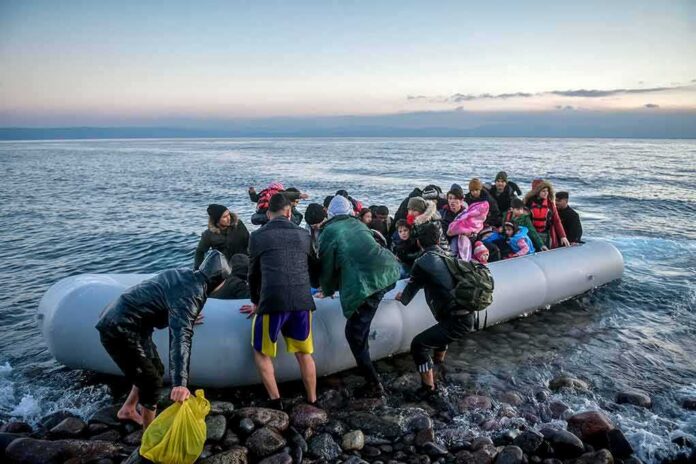
Four people died and dozens were rescued after powerful currents stranded migrants on a French beach during a failed English Channel launch.
Story Snapshot
- French officials reported four deaths and at least 38 rescues near Equihen-Plage.
- Strong currents swept people into the sea during boarding for a “taxi-boat” crossing.
- Rescues and fatalities near shore now happen more often than mid-channel wrecks.
- Recent data shows ongoing deaths despite major rescue efforts on both sides.
What Happened At Equihen-Plage
French authorities said two men and two women died on Thursday near Equihen-Plage on the northern coast. The regional prefect, François-Xavier Lauch, said currents swept people away as they tried to board an inflatable “taxi-boat” for the United Kingdom. Emergency teams rescued at least 38 people, and one person needed urgent medical care, according to on-scene statements. Photos and video from the site showed scattered belongings on the sand and responders treating people on the beach.
Local officials described a chaotic scene as the sea turned rough near the launch point. People were in the water without life jackets. Others were stuck on the beach while the boat drifted. The prefect said responders moved fast to pull people from the surf and treat hypothermia. Reporters at the site documented the timeline and response. The incident fits a string of near-shore emergencies this year on the French side of the Channel.
Why Near-Shore Launches Are So Deadly Now
Border research groups and aid workers say many accidents now happen during boarding or right after launch. Overcrowding, flimsy boats, and quick police actions can push groups to rush into the water. That raises the risk of crush injuries, falls, and drownings close to shore. Analysis of French coastguard data shows a shift from rarer offshore wrecks toward frequent near-shore incidents tied to crowding and unstable loading areas.
Officials in both countries have boosted patrols and rescues, yet the risks remain. The University of Oxford’s Migration Observatory reports at least 162 deaths in the Channel from 2018 to 2025, and more when nearby, migration-linked incidents are included. The group logged 24 confirmed Channel deaths in 2025, down from 73 in 2024, but the danger persists as boats carry more people and launch in poor conditions to avoid detection.
The Bigger Picture: Policy, Smugglers, And Rescue Limits
French and British leaders say they are cracking down on smugglers and stopping launches. French police report hundreds of prevented departures. Critics argue that harder borders push crossings into riskier spots and times. Both views point to the same pattern on the sand: larger groups racing the tide, weak boats taking on water, and rescue crews straining to reach people fast enough when plans fall apart at the shoreline.
Rescue teams continue to save many lives, but they cannot erase the danger. Lifeboat crews have handled hundreds of small-boat calls in recent years and have saved many people. Still, the Channel’s cold water, strong currents, and crowded inflatables turn small errors into mass-casualty events within minutes. After the Equihen-Plage incident, authorities again urged people not to risk the crossing and vowed to pursue smuggling networks behind these launches.
What This Means For Voters Watching From Afar
American readers see a familiar cycle here: tough talk, big budgets, and tragic outcomes that keep repeating. Europe’s border grind mirrors debates at home about enforcement first, aid versus deterrence, and whether government systems meet the test of basic duty. The lesson is sober. When policy does not match on-the-ground reality, criminal groups fill the gap, and ordinary people pay the price on a cold beach while officials trade blame.
For citizens across the spectrum, the shared concern is competence. People want borders managed and lives protected. They also want tax dollars to produce results, not headlines. The Channel shows how hard problems get worse when strategies focus on optics over outcomes. Clear goals, better data sharing, and real consequences for smugglers could save lives. Until then, we should expect more near-shore rescues, more grief, and more broken promises from leaders.
Sources:
bbc.com, news.sky.com, telegraph.co.uk, independent.co.uk, nytimes.com