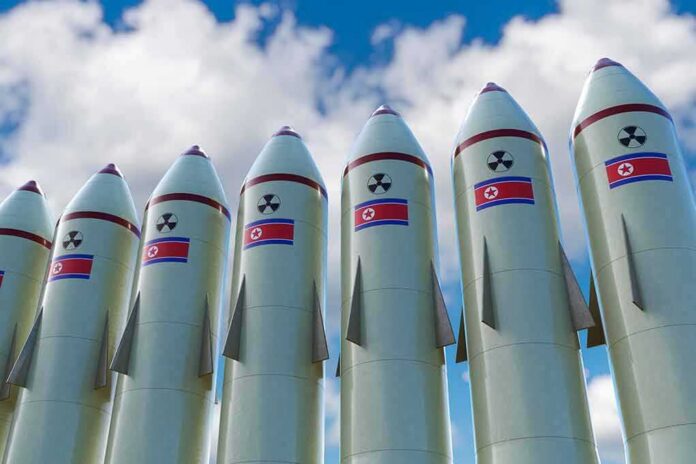
United Nations nuclear watchdog members formally warned that North Korea is expanding uranium enrichment, signaling a faster path to more bombs and less accountability.
Story Snapshot
- The International Atomic Energy Agency (IAEA) reported new and expanded uranium enrichment facilities in North Korea.
- Member states passed a resolution expressing “growing concern” over increased atomic activity.
- IAEA chief Rafael Grossi labeled the developments a “serious concern” tied to security risks.
- North Korea dismissed denuclearization calls and claimed its nuclear status is irreversible.
What the IAEA Says Is New on the Ground
Reuters, citing the International Atomic Energy Agency, reported that North Korea built a new uranium enrichment facility at its main Yongbyon complex that could house up to 28 centrifuge cascades. The agency also said an expanded annex at the Kangson site has started operating. These findings point to added capacity to make highly enriched uranium, which can fuel nuclear warheads. The agency relies on satellite imagery and other remote tools because inspectors have had no access inside the country for years.
International Atomic Energy Agency Director General Rafael Grossi called the ongoing operation and reported expansion a “cause for serious concern.” His warning highlights a simple risk: more machines mean more nuclear material that can be turned into weapons. That can pressure neighbors, trigger more tests, and raise the chance of mistakes. Grossi has pushed for talks and access, but North Korea has rejected the agency’s role and authority in recent years.
What Member States Did in Vienna
Members of the International Atomic Energy Agency adopted a resolution that voiced “growing concern” about North Korea’s nuclear activity. The text cited the country’s reported long-term plan to strengthen its nuclear force and called on Pyongyang to halt work that violates United Nations Security Council measures. Supporters argued that added enrichment space and reactor activity raise regional and global security risks, and they urged cooperation with the agency’s monitoring and safeguards.
United States, European Union, and allied statements at the board level have tied the IAEA’s findings to a pattern of repeated missile launches and open pledges to expand the arsenal. Those governments say the combination undermines nonproliferation norms and stresses defenses in Northeast Asia. Japan’s envoy echoed these points and pressed for North Korea to comply with its obligations and return to talks. The collective message aimed to keep pressure on Pyongyang and to show unity among member states.
How Pyongyang Responded and Why It Matters
North Korea rejected the denuclearization push and mocked the IAEA concerns as “nonsense.” Kim Yo-jong, a senior official, said the country’s status as a nuclear-armed state is “immutable,” and that nothing could reverse it. She framed the program as a self-defense shield and said outside pressure would not change policy. This messaging signals no near-term shift and sets a hard line that complicates any return of inspectors or limits on enrichment.
Reuters also reported that Kim Jong Un earlier called the nuclear deterrent “self-defensive” and “irreversible,” linking it to national security and economic goals. That narrative is designed to justify continued building while denying outside oversight. It also raises the political cost for Pyongyang to trade away capacity later. For neighbors and the United States, that means fewer off-ramps and more focus on sanctions, missile defense, and alliances to manage risk.
The Verification Gap and the Stakes for Ordinary People
The International Atomic Energy Agency has not had access to North Korea since 2009. The agency’s own reporting says it cannot confirm the exact configuration or operations at these sites without on-the-ground inspections. Still, the mix of satellite images, thermal data, and public signals has been consistent over time: activity continues and capacity grows. This gap leaves the world tracking risk by inference, not by direct checks, which weakens trust and speeds miscalculation.
IAEA members raise 'concern' over North Korea nuclear expansionhttps://t.co/YJN4TqxkKe
— The Peninsula Qatar (@PeninsulaQatar) September 17, 2026
For Americans, this is one more sign that global watchdogs warn, governments resolve, and adversaries push ahead anyway. Voters on the right see failed international promises and rising danger. Voters on the left see growing nuclear risk and shrinking transparency. Both see a system that talks more than it delivers. When oversight depends on satellites instead of inspections, elites hold meetings while families live with the fallout of higher prices, stretched defense budgets, and a more dangerous world.
Sources:
insiderpaper.com, reuters.com, thepeninsulaqatar.com, upi.com, beyondparallel.csis.org, isis-online.org, voanews.com, scribd.com