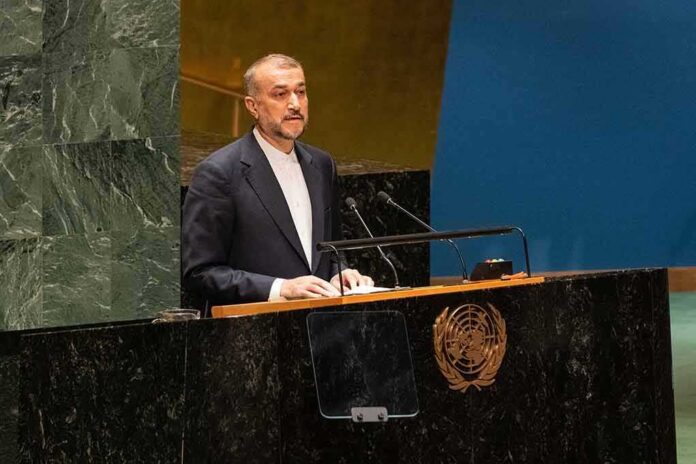
The United Nations voted 164–1 to urge schools and publishers to use a world map that shows Africa’s true size, while the United States stood alone against it.
Story Snapshot
- The United Nations endorsed promoting the Equal Earth projection; the vote was nonbinding.
- Togo led the push on behalf of African states, with backing from the African Union.
- Supporters say common Mercator maps shrink Africa and inflate northern regions.
- The United States called the measure ideological and voted no as the sole opponent.
What The United Nations Actually Approved
On September 4, the United Nations General Assembly adopted a resolution urging wider use of equal-area world maps, highlighting the Equal Earth projection, by a vote of 164 to one with six abstentions. The text does not ban the Mercator projection or force any country to change maps. It is nonbinding guidance for education and general use. The measure’s stated aim is to reduce visual distortion that downplays Africa’s scale on many classroom and media maps.
Togo introduced the resolution on behalf of African states, with support from the African Union, arguing that maps shape how people see power and place. Advocates said the Equal Earth projection keeps land areas in true proportion, so continents near the equator no longer appear smaller than they are. They framed this as a fairness and accuracy fix for students and the public, not a change to borders or sovereignty.
Why The Map Choice Matters
Most of us learned world geography with the Mercator projection, which keeps angles accurate but makes areas near the poles look far larger than they are. That is why Greenland can look close to Africa’s size in many wall maps, even though Africa is about 14 times larger, a point repeated in coverage of the vote. Equal Earth is designed to show true areas more faithfully at the world scale, which can help correct those size myths in classrooms.
Cartography experts say every projection distorts something. The core choice is which property to protect and for what task. Mercator remains useful for navigation because it preserves angles, which helps with bearings and routes. But for world maps in textbooks or news graphics, equal-area designs avoid telling viewers, even by accident, that some regions are smaller or less important than they are. The United Nations resolution focuses on these general-use settings.
Why The United States Voted No
The United States delegation said the measure pushes an ideological agenda and distracts the United Nations from pressing global problems. U.S. statements before the vote argued that debating centuries-old projections, and linking them to ideas like reparations or “cognitive justice,” harms the body’s credibility. The United States was the only country to vote against the resolution, setting up a clear political split even as the text itself remains nonbinding.
The UN General Assembly has voted to adopt a new world map projection that shows the size of Africa and other continents more accurately.
The “Correct The Map” resolution, sponsored by Togo and backed by African Union member states, received support from 164 countries. The… pic.twitter.com/tDuDLYWVtK
— Ⓝⓖ'ⓞⓡⓞⓡⓘⓔⓣ🐐🇰🇪 (@baroswahjr) September 5, 2026
For Americans, this lands in a wider debate about institutions and priorities. Supporters see a long-overdue fix to a map that hides Africa’s true heft, which influences how people think about trade, resources, and history. Critics see mission drift at the United Nations when wars, debt, and migration demand focus. Both concerns point to a common worry at home: big institutions often spend time on symbolism while daily problems get worse.
What Changes Next
Because the resolution is nonbinding, change depends on schools, publishers, and media choosing different default maps. United Nations agencies and large textbook companies may shift first, but adoption could be uneven and slow. Navigation and some technical uses will still rely on Mercator or other projections built for those jobs. The practical test will be simple: what hangs in classrooms, what appears on news screens, and what projection digital platforms set as their world-view default.
Sources:
diplomacyandlaw.com, newscord.org, debate.com.mx, english.aawsat.com, en.wikipedia.org, ctvnews.ca, thenationalnews.com, armenpress.am, ua.news