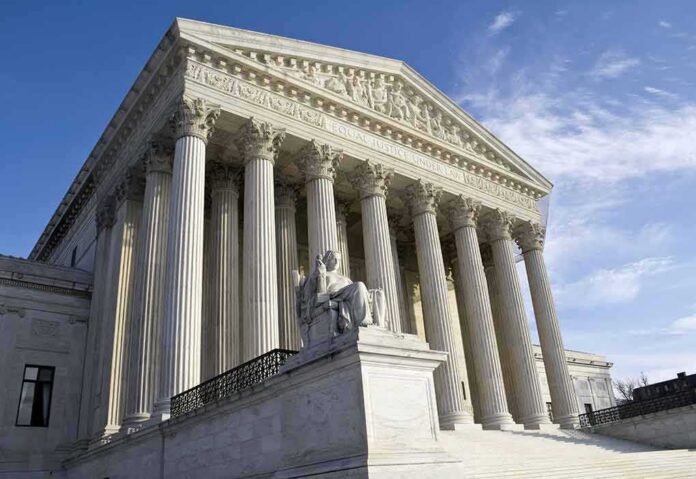
The Supreme Court’s emergency order lets the government restart nationwide citizenship checks that lower courts said risked privacy violations and wrongful voter flags.
Story Snapshot
- The Supreme Court temporarily allowed use of the expanded SAVE system during appeals.
- Officials say SAVE speeds up status checks and only reports results to states, which choose whether to use it.
- Lower courts said the expansion likely broke privacy laws and could misidentify citizens as noncitizens.
- Public records do not show error rates or safeguards for bulk matching at scale.
What the Supreme Court Allowed, and What It Did Not
The Supreme Court issued temporary relief that lets the administration use the revamped Systematic Alien Verification for Entitlements program while litigation continues. The order is not a final ruling on legality. It preserves the government’s ability to provide citizenship or immigration status matches back to states before the election. The Court did not resolve claims under the Social Security Act or Privacy Act. Those arguments remain live on appeal and could still decide the program’s fate.
The Department of Homeland Security redesigned the service to support bulk voter roll checks with faster queries. The Department of Justice said the changes allow matching with status records and, in some cases, Social Security data to improve speed and reliability. The administration argues SAVE does not remove anyone from voter lists. It sends match responses to states, which decide what to do with the information. States are not required to use SAVE, and participation is voluntary.
What SAVE Is and How It Would Be Used by States
United States Citizenship and Immigration Services describes SAVE as an existing federal service for agencies to verify immigration status and U.S. citizenship. Agencies can submit information one record at a time or in bulk, and SAVE returns a verification response for that record set. The government says this helps states maintain voter lists by checking citizenship claims against federal files and flagging mismatches for state review. The administration frames this as support for faster, more accurate checks.
The Solicitor General told reporters and the Court that SAVE “does not disqualify any voter.” It only confirms whether federal data can verify citizenship for a provided identity match, leaving decisions to local officials. Some filings and reporting describe limited use of Social Security Administration information alongside Department of Homeland Security records to verify details in certain cases, which the government says can speed bulk checks. That linkage is at the core of the legal fight over privacy and data sharing.
Why Courts and Advocates Are Alarmed
A federal district judge ruled in June that the expansion was unlawful, saying agencies combined large pools of personal data in ways that broke privacy laws and risked harming eligible voters. A split panel of the United States Court of Appeals for the District of Columbia Circuit left that ruling in place this month, finding likely violations tied to disclosure of Social Security numbers and other sensitive data. The appeals court also warned the system could return “false negatives,” wrongly labeling citizens as noncitizens.
Supreme Court lets Trump administration use revamped federal voter eligibility database for now:
'States’ use of the SAVE program is voluntary. The immediate impact on the upcoming midterms is likely limited because existing law blocks most states from systematically purging…— Blue Paul (@gobacktosanity) September 25, 2026
Local reviews show how errors can land. Officials in Travis County, Texas, examined 97 voters flagged by SAVE and found at least 10 percent, and likely up to 21 percent, were citizens. National Public Radio reported that some eligible voters have been flagged as potential noncitizens, echoing warnings from voting experts about data quality and naturalized citizens. A Department of Homeland Security privacy document has acknowledged that typos, number swaps, or incomplete data can produce inaccurate results.
What We Still Do Not Know, and Why It Matters
The record does not include a public validation study for bulk matching, including false-positive or false-negative rates at scale. There is no shared dataset showing how many state queries were run, how many mismatches were resolved, or how many citizens were wrongly flagged. Clear safeguards, such as notice rules, correction steps, and timelines for fixes, are not described in public materials provided here. That leaves both risks and benefits hard to measure before voting begins.
For readers worried about both illegal voting and wrongful removal, this is the core tension. The government says SAVE is a tool to help states verify faster and not a purge machine. Critics point to court findings and early error reports that show real people can get swept up by bad data. The Supreme Court’s move keeps the tool online for now. The legal and technical tests ahead will show whether it can work without crossing privacy lines or blocking eligible Americans from the ballot.
Sources:
cbsnews.com, 3newsnow.com, newsday.com, semissourian.com, reuters.com, washingtonexaminer.com, washingtontimes.com, cnn.com, politico.com, news.bloomberglaw.com