

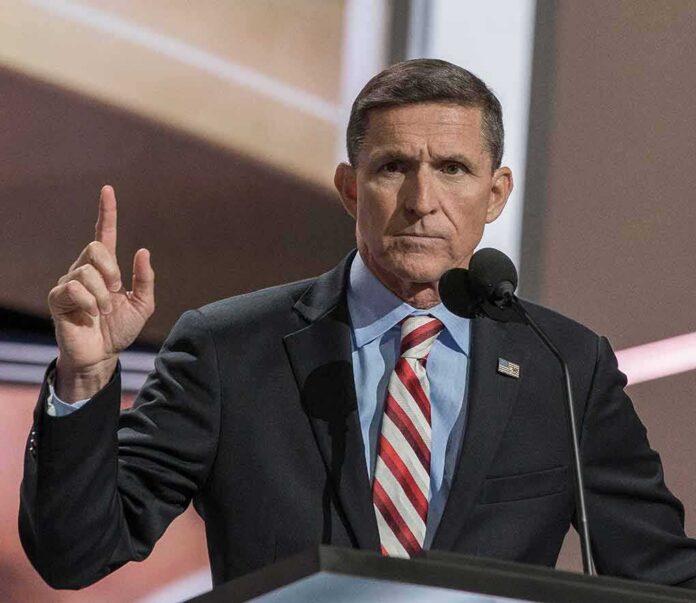
Newly released agent notes from Michael Flynn’s 2017 FBI interview differ from the official report that helped secure his guilty plea, reviving doubts about how federal power is used and recorded.
Story Highlights
- Handwritten notes from both interviewing agents surfaced alongside the later FD-302 summary.
- Reported note fragments show Flynn expressing uncertainty, not clear denials.
- The formal FD-302 was entered more than 20 days after the interview.
- A prior court found the reports and notes “consistent,” underscoring the dispute.
What the Newly Released Documents Show
Public reporting says the document set includes handwritten notes by former Federal Bureau of Investigation agents Peter Strzok and Joe Pientka from the January 24, 2017 interview, plus the later FD-302 summary. The notes quote Flynn with phrases like “Not really. I don’t remember. Hey don’t do anything,” which signal uncertainty about details discussed with Russia’s ambassador. These notes now sit next to the official 302 that prosecutors later used, creating a line-by-line tension in how the interview was captured.
Coverage also highlights timing. Reports say the FD-302 was entered into the Federal Bureau of Investigation system more than 20 days after the interview. That gap matters because these reports are not verbatim transcripts. Agents draft them from memory and rough notes after the fact. When a case turns on exact wording and tone, a later summary can read different from raw, in-the-moment notes, even when both aim to be accurate.
Why This Sparks Bipartisan Frustration
Americans across politics worry that the government writes its own version of events, then treats that version as final. The Flynn materials speak to that fear. Handwritten notes show a man groping for details under pressure, while the later 302 reads more settled. For many, that looks like the system stacking the deck. For others, it shows normal process. Either way, when trust is low, a slow, edited record fuels doubts that the powerful play by the same rules as everyone else.
There is also the “paper-record substitution” problem. Federal agents usually do not record interviews. They take notes, then write the FD-302 later. Courts and lawyers have long wrestled with gaps between notes and the final narrative. The Flynn dispute fits that pattern. It does not, by itself, prove lying by agents. But it does highlight a known weak point in federal practice that can tilt outcomes when livelihoods and liberty are on the line.
What Flynn’s Supporters and Critics Each Point To
Flynn’s allies say the new notes undercut the core claim that he knowingly lied. They point to language that shows hazy recall and a non-confrontational tone during questions about calls and sanctions, not flat denials. They argue that a delayed and polished 302 cannot stand above what agents wrote in the room, and that any edits or rewrites should be made public with dates and authors. That view sees the record as flawed and the process as biased.
Ret. Lt. Gen. Michael Flynn explained how the Comer-era FBI “lied” about him. pic.twitter.com/hxEvhzSeHB
— NEWSMAX (@NEWSMAX) September 20, 2026
Critics answer that the court already reviewed the agents’ notes, draft reports, and the final 302 and found them consistent on the key point: Flynn made false statements about his talks with the Russian ambassador. They stress that disagreements over phrasing are common and do not erase the substance. They also note that an arrest or charge is not the same as a conviction, yet the justice system must still rely on standard tools like 302s to move cases forward.
What We Still Do Not Know
The public has not seen a full, high-resolution set of every handwritten page and every draft 302 with edit logs. Without that, it is hard to judge how the summary took shape or whether supervisors suggested changes. A direct audio or video would have settled the words used. That record does not exist. So the debate leans on fragments, timelines, and trust in process. More disclosure could narrow the gap, but it may not end it.
Why This Matters Beyond Flynn
This fight is bigger than one case. When unrecorded interviews drive charges, power flows to the note-taker. Most Americans cannot afford that risk. Clear rules could help, like default audio recording of federal interviews, automatic release of draft histories, and strict clocks for report filing. These steps would not pick a side. They would protect the public record, which protects all of us. In a time of deep cynicism, small fixes can rebuild trust.
Sources:
youtube.com, justthenews.com, politico.com, en.wikipedia.org, docs.house.gov