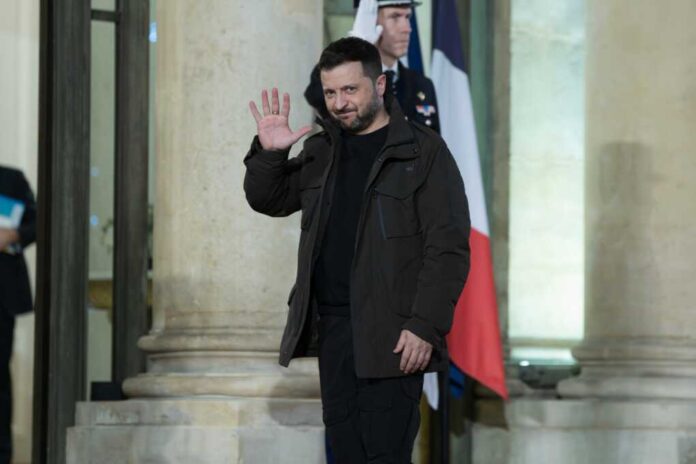
Four unidentified military-style drones reportedly stalking Volodymyr Zelensky’s jet into Dublin should be a wake-up call about how fragile Western airspace really is.
Story Highlights
- Four large, military-style drones reportedly breached a no-fly zone near Dublin Airport as Zelensky’s plane arrived for a state visit.
- Irish and European officials treat the incident as a likely hybrid operation testing air defenses rather than a direct assassination attempt.
- The drones later reportedly circled an Irish Naval Service vessel that had no effective tools to bring them down.
- The scare underscores how underfunded European defenses and neutral postures invite probing by hostile actors.
Drones challenge Dublin’s air security
Reports from Irish, Ukrainian, and international outlets describe four relatively large, military-style drones breaching a temporary no-fly zone around Dublin Airport as Volodymyr Zelensky’s aircraft arrived for a state visit. The devices reportedly flew along the approach path where his jet had been expected just moments earlier, suggesting more than random hobbyist activity and raising questions about who wanted to test or intimidate a visiting wartime president on friendly soil.
Security sources quoted in Irish media say the drones likely launched either from the northeastern suburbs of Dublin or from a vessel offshore that slipped past radar coverage, then shifted focus once the aircraft was safely on the ground. After missing the approach window, the drones reportedly converged on the Irish Naval Service patrol vessel LÉ William Butler Yeats, circling or tracking the ship even though it lacked real-time means to disable or capture the intruders during the incident.
Watch;
Hybrid warfare probes Western weaknesses
The suspected Dublin hybrid operation fits a broader pattern seen since Russia’s full-scale invasion of Ukraine, where hostile players rely on deniable tools like drones, cyberattacks, GPS jamming, and disinformation campaigns to probe Western defenses. European airports in countries such as Germany, Denmark, and Belgium have already endured repeated drone incursions and temporary shutdowns, signaling that airspace around critical infrastructure and VIP movements is now a favorite testing ground for adversaries seeking leverage without crossing into open war.
Read "Zelensky’s plane ‘followed by military drones’ before Dublin visit in ‘hybrid attack’" on SmartNews: https://t.co/7vQiQ8uRAh #SmartNews
— Michael Drysch (@HalfCourtMikeD) December 4, 2025
These low-cost, high-nuisance operations aim to create uncertainty, embarrass friendly governments, and remind European publics that their leaders cannot fully guarantee security. For American readers, this should sound familiar: the same globalist complacency and underinvestment that produced porous borders often leaves skies and networks exposed overseas.
Ireland’s neutrality meets modern threats
Ireland’s long-standing military neutrality and relatively modest defense spending collide here with a twenty-first-century threat environment built around drones, precision weapons, and persistent electronic interference. Domestic critics have warned for years that Dublin’s radar coverage, aerial surveillance, and counter-drone capabilities lag far behind the realities of modern conflict, and this episode hands them a vivid example: a visiting wartime president, a breached no-fly zone, and a naval patrol vessel effectively forced to watch sophisticated drones operate overhead.
High stakes for Europe and America
In the immediate term, the Dublin drone scare is likely to drive rapid procedural changes for VIP visits across Europe, including wider exclusion zones, layered detection, and tighter coordination between national authorities, aviation regulators, and naval or air assets. The episode also underscores psychological risks: if even the plane of a wartime head of state can be shadowed into EU territory, ordinary travelers and citizens may reasonably doubt whether their leaders take modern threats seriously enough to invest in real defenses instead of performative statements.
Longer term, security pressure will probably push Ireland toward higher defense and surveillance budgets and deeper integration with European and possibly NATO frameworks on hybrid threats, even if Dublin keeps its formal neutrality label.
Sources:
Zelensky’s plane ‘followed by military drones’ before Dublin visit in ‘hybrid attack’ – The Independent
Drones over Dublin: suspected ‘hybrid warfare’ and Ireland’s airspace vulnerabilities – TheJournal.ie
Four military-style drones breach Dublin no-fly zone as Zelensky arrives – Kyiv Post