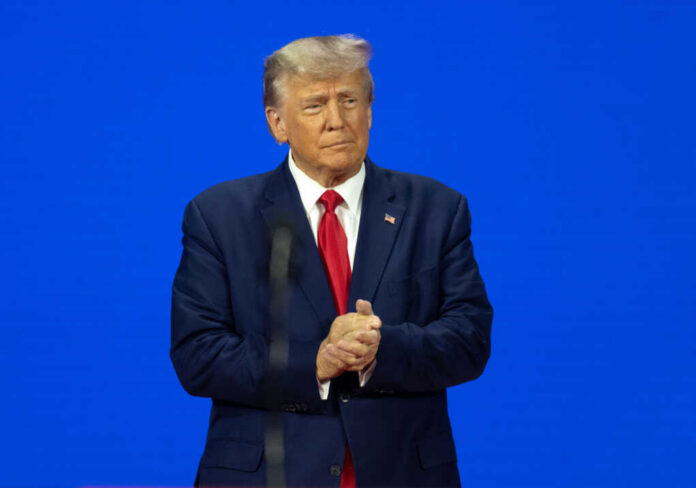
After weeks of brinkmanship that threatened America’s economy and the world’s oil supply, President Trump now says the Iran war is “very close to being over.”
Story Snapshot
- Trump told Maria Bartiromo the conflict with Iran is “very close to being over,” pointing to a ceasefire and renewed talks.
- The latest de-escalation follows U.S. strikes on Iran’s key oil-export infrastructure and pressure tied to the Strait of Hormuz.
- A two-week ceasefire announced April 8 includes Iran’s commitment to safe passage in Hormuz, a chokepoint for global energy.
- The conflict is colliding with a U.S. constitutional fight over presidential war powers and Congress’s role in authorizing force.
Trump Signals an Endgame as the Ceasefire Holds
President Donald Trump said in a Fox Business conversation with Maria Bartiromo that the war with Iran is “very close to being over,” a notable shift from earlier escalation messaging. The remark comes as a two-week ceasefire—announced April 8—continues to frame the day-to-day reality on the ground. Trump has portrayed the pause as proof U.S. objectives were met and that negotiations are moving toward a more durable arrangement.
Trump’s comments land at a moment when Americans are wary of open-ended foreign conflicts but also unwilling to accept threats to global commerce. Iran’s posture around the Strait of Hormuz became the central trigger because the waterway carries a significant share of global oil shipments, making any disruption a kitchen-table issue through energy prices. The administration has treated restoring secure passage as a strategic necessity rather than a purely regional dispute.
Hormuz and Energy Pressure Drove the Military Timeline
U.S. and Israeli strikes earlier in the conflict targeted Iranian capabilities tied to oil exports and maritime pressure, including facilities on or near Kharg Island, described as critical to Iran’s crude export capacity. The administration’s approach paired military force with economic leverage, including a reported U.S. blockade on Iranian ports after Iran’s actions around Hormuz. For voters still frustrated by past inflation spikes, the link between security and energy markets is hard to ignore.
The April 8 sequence illustrates how rapidly escalation can turn into negotiation when economic stakes are high. Trump publicly set an evening deadline for Iran to reopen Hormuz, warning that additional strikes could hit infrastructure such as power plants, bridges, and desalination facilities. That same evening, the administration announced a mutual two-week ceasefire and circulated a statement from Iran’s foreign minister indicating defensive operations would pause if attacks stopped and safe passage would be restored.
Pakistan Mediation and Competing Narratives About “Victory”
Negotiations have been described as advancing through Pakistan’s mediation, with Iran submitting a multi-point proposal as the ceasefire began. Trump’s public framing emphasizes completion—suggesting the mission is effectively accomplished and the deal is nearing closure. Critics, including some online commentary, argue the messaging looks like a retreat rather than a win. The available reporting supports the existence of a ceasefire and talks, but it does not, by itself, prove a final agreement is imminent.
War Powers Questions Return as the Clock Nears 60 Days
Domestic politics now intersect with the military timeline in a way that both parties have historically exploited when convenient. The conflict began without congressional authorization, reviving long-running disputes over the War Powers Resolution and whether presidents can sustain hostilities past statutory limits without explicit approval. Civil-liberties advocates have argued the campaign is illegal absent congressional authorization, while congressional efforts to constrain the operation have struggled to advance in a polarized environment.
What This Means for Americans Who Don’t Trust Washington
Trump’s “close to over” message may reassure voters who want strength without endless war, but the ceasefire’s durability remains the key question. The reporting available so far highlights a pause in operations and a commitment to safe Hormuz passage for a limited window, not a verified long-term settlement. For Americans across the political spectrum who believe government serves insiders first, the episode underscores how quickly high-stakes decisions can be made—and how hard it can be to get clear accountability once events are underway.
Limited social media research was provided in a way that included no clearly relevant English X/Twitter links suitable for the required secondary insert, so only a qualified YouTube link was used above.
Sources:
Trump Declares ‘End Of Iran Conflict’ As New Negotiations …
Trump says US-Iran war ‘very close’ to ending amid …
Iran-US war latest: Trump claims war is close to over as US …
US enforces naval blockade on Iran as nuclear issue takes …