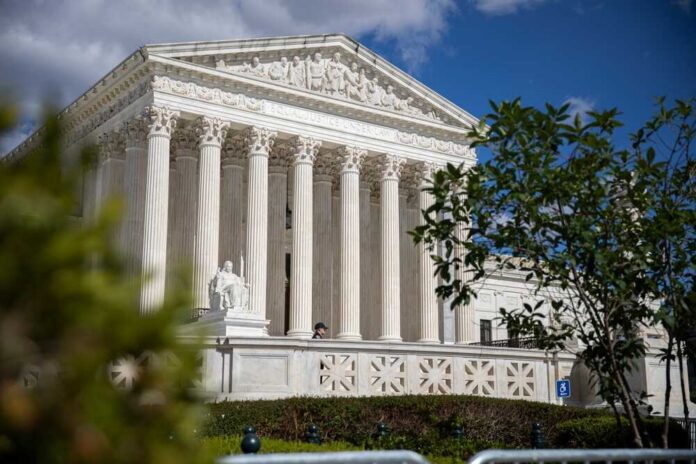
A federal appeals-court win is keeping Trump’s mandatory ICE detention policy alive—setting up a high-stakes Supreme Court showdown over how far executive power can go in immigration enforcement.
Quick Take
- The 5th Circuit let stand a ruling upholding Trump’s policy requiring detention for many illegal immigrants during deportation proceedings, with limited access to bond.
- The administration has now notched appellate wins in the 5th and 8th Circuits, even as many district judges across the country have rejected the approach in thousands of cases.
- Courts have largely focused on statutory authority under the 1996 immigration law, while leaving open constitutional due-process questions around bond hearings.
- The growing patchwork of rulings increases the odds the Supreme Court will step in, with major consequences for ICE operations and detention capacity.
What the 5th Circuit decision actually did
The U.S. Court of Appeals for the 5th Circuit allowed a February panel decision to stand that upheld the Trump administration’s mandatory detention policy for illegal immigrants facing deportation proceedings. The panel ruled 2-1 that presidents have authority under the 1996 Illegal Immigration Reform and Immigrant Responsibility Act to detain certain immigrants without bond while their cases move forward. When the full 5th Circuit declined to rehear the case en banc, the ruling became more entrenched in Texas, a major hub for ICE detention.
That matters because the 5th Circuit’s territory includes states where federal immigration detention is a central tool of enforcement. The administration portrays the appellate rulings as a necessary correction to what it calls lower-court resistance. Critics argue the policy is overly sweeping and departs from how prior administrations handled bond and custody decisions. The legal fight now hinges on whether the 1996 law merely permits detention or can be read to require it broadly, even when hearings are requested.
Two appellate wins, but thousands of lower-court losses
Trump’s team is building momentum at the appellate level: the 5th Circuit ruling is described as the administration’s second circuit-court win after a separate 8th Circuit panel upheld the policy in March. At the same time, reporting cited in the research shows a striking divide in the trial courts. More than 400 district judges—appointed by presidents of both parties—have rejected the policy in over 5,000 cases, while a smaller group of roughly 41 judges has upheld it in about 250 cases. That contrast fuels claims of “activist judging” on one side and “executive overreach” on the other.
The 8th Circuit decision also underscored that this is not a clean ideological story, even if politics saturates the debate. The majority included a George W. Bush appointee and a Trump appointee, while a Trump-appointed judge dissented. That lineup suggests the legal question is genuinely contested among conservatives as well: how to balance Congress’s immigration framework, a president’s enforcement duties, and basic procedural fairness. The split also creates uncertainty for families, employers, and communities trying to understand what rules apply in different states.
Where due process enters—and where courts avoided it
One reason this fight is headed toward the Supreme Court is that the appellate rulings, as summarized in the research, largely address statutory interpretation while leaving constitutional questions in play. The policy’s opponents argue prolonged detention without a meaningful bond hearing raises due-process concerns, especially when deportation proceedings can drag on. The research also notes that after the 5th Circuit ruling, more than 10 Texas judges shifted their focus toward due-process grounds when denying bond, signaling the next stage of litigation may center less on the 1996 statute and more on constitutional safeguards.
For conservatives who prioritize ordered liberty, that distinction matters. Congress can set tough immigration rules, and presidents can enforce them, but the system still has to demonstrate transparent standards and consistent procedures. When district courts and circuits pull in opposite directions, Americans see a government that looks arbitrary—harsh in one jurisdiction, lenient in another—while costs rise and confidence falls. Even voters who want stronger border control often want the rules to be clear, predictable, and defensible in court.
Why a Supreme Court review could reshape enforcement nationwide
The immediate effect of the appellate wins is practical: ICE can rely more confidently on detention authority in the 5th and 8th Circuits, at least on the statutory question. The longer-term stakes are national. A Supreme Court decision could either validate the administration’s reading of the 1996 law or impose limits that restore broader access to bond hearings. The research indicates other circuits, including the 7th and 9th, have related disputes pending, raising the possibility of conflicting national standards that only the Supreme Court can settle.
Politically, this case lands in the center of an already-bitter argument about whether Washington can still execute basic responsibilities: control who enters the country, adjudicate claims quickly, and remove those who have no legal right to stay—without trampling constitutional protections. Attorney General Pam Bondi publicly framed the 8th Circuit ruling as a major win against “activist judges,” while immigrant-rights advocates have labeled the legal theory “radical.” With detention capacity, budgets, and court backlogs all under pressure, the Supreme Court’s next move could determine whether immigration enforcement becomes more uniform—or even more contested.
Sources:
mandatory detention ruling 8th circuit
trump mandatory immigration detention upheld