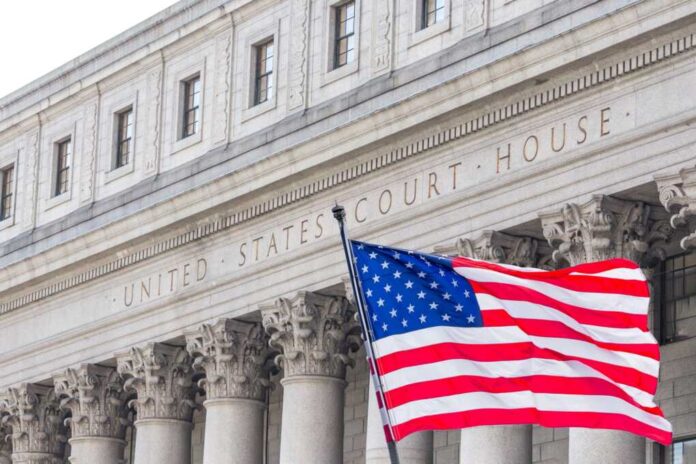
The Supreme Court is set to hear oral arguments in a landmark case challenging the century-old independence of the Federal Reserve. The conflict centers on President Trump’s attempt to fire Fed Governor Lisa Cook, who argues the “for cause” removal allegations are a pretext for her policy dissent. The ruling will define the limits of presidential removal power, testing whether it can override Congressional intent to shield monetary policy from political influence, with implications for the future stability of the American economy.
Story Highlights
- Supreme Court hears arguments January 21 on Trump’s authority to fire Fed Governor Lisa Cook “for cause.”
- Case tests Federal Reserve independence in biggest challenge since 1913, with Cook claiming pretext over policy disagreements
- Trump cites alleged mortgage application misrepresentations; lower courts blocked removal pending review
- Ruling could define presidential removal power and risk politicizing monetary policy, affecting economic stability
Presidential Authority Collides With Fed Independence
The Supreme Court prepares to hear oral arguments on January 21, 2026, in a landmark case challenging Federal Reserve independence. President Trump attempted to fire Fed Governor Lisa Cook in August 2025, citing “deceitful and potentially criminal” mortgage application misrepresentations. Cook sued to retain her position, arguing the allegations serve as pretext for her policy dissent. The case directly tests whether presidential removal power can override congressional protections designed to insulate monetary policy from political pressure.
Lower Courts Block Trump’s Removal Attempt
U.S. District Judge Cobb initially ruled Cook could remain pending judicial review, a decision the D.C. Circuit Court of Appeals upheld 2-1. Trump’s administration appealed to the Supreme Court in September 2025, seeking emergency intervention to pause lower court orders and proceed with the firing. The administration argues any presidential reason suffices for removal, regardless of factual basis, calling judicial interference improper. Cook maintains the firing would make the Fed “subservient to the President’s will,” undermining the institution’s constitutional role.
Constitutional Stakes and Statutory Interpretation
The Federal Reserve Act of 1913 grants governors 14-year terms, removable only “for cause” – an undefined term Congress intended to shield monetary policy from political interference. Unlike recent Supreme Court rulings striking down for-cause protections in other agencies, this case treats the Fed as a “uniquely structured, quasi-private entity” with distinct historical precedent. The Court must interpret whether “for cause” requires a factual basis and judicial review, or allows unilateral presidential discretion as the administration claims.
Professional Daniel Tarullo from Harvard Law describes this as a “test case of whether there is any limit to untrammeled power for the president.” The Roberts Court has previously favored unitary executive theory while recognizing the Fed’s special constitutional footing. A weak standard for removal could politicize monetary policy, potentially leading to inflationary pressures and economic instability as Fed decisions become subject to presidential politics rather than economic analysis.
🚨BREAKING: the SUPREME COURT might be forced into stopping Democrat Fed Governor Lisa Cook from attending the upcoming Fed meeting where they decide on interest rates because of her mortgage fraud, and firing by President Trump.
Do you support this?
YES or NO? pic.twitter.com/z5GKmfpbY3
— Red Eagle Updates 🦅🇺🇸 (@RedEagleUpdates) January 11, 2026
Broader Implications for Executive Power
This case represents the Fed’s biggest independence test in over a century, with implications extending beyond Cook’s position. The ruling will clarify presidential removal authority across independent agencies while potentially setting precedent for future executive branch control. Chair Jerome Powell recently acknowledged DOJ subpoenas regarding unrelated renovations, signaling broader tensions between the administration and Fed leadership. The outcome could either preserve congressional intent for Fed independence or expand presidential authority over monetary policy, fundamentally altering the balance of economic power in American government.
Watch the report: BREAKING: Supreme Court Just Handed Trump Control of the Federal Reserve
Sources:
Federal Reserve Inquiry Clouds Trump’s Supreme Court Bid to Oust Lisa Cook – The New York Times
The Fed-firing case in three steps – SCOTUSblog
Will the Federal Reserve Remain Independent?
Trump v. Cook: An explainer
Will the Supreme Court continue to protect the Federal Reserve from Donald Trump? | CNN Politics