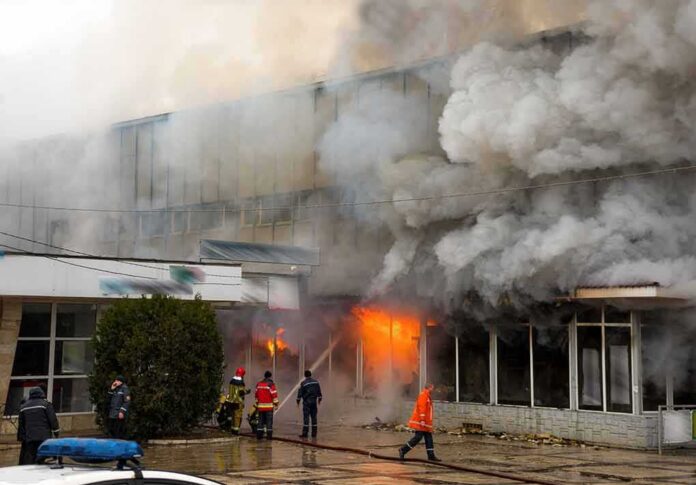
A daytime drone strike hit Ukraine’s main security service building in central Kyiv, underscoring how the war is now targeting core state institutions.
Story Highlights
- Officials said a Russian drone struck the Security Service of Ukraine headquarters in downtown Kyiv.
- President Volodymyr Zelenskiy said the drone aimed at the acting security chief’s office.
- Ukraine’s foreign minister called the strike a serious escalation requiring a response.
- Reports described smoke and multiple injuries as emergency crews worked at the site.
Strike On Security Service Headquarters In Central Kyiv
Ukrainian leaders said a Russian drone hit the Security Service of Ukraine headquarters on Volodymyrska Street on Friday afternoon, in the heart of Kyiv’s historic center. President Volodymyr Zelenskiy stated the drone targeted the office of the service’s acting chief inside the building. Reporters on the ground saw heavy black smoke rise after impact, and city officials reported injuries from the broader strike wave that hit the area. The building sits across from St. Sophia Cathedral, a major landmark.
Accounts of injuries varied across outlets as first responders worked the scene. Reuters cited Kyiv’s mayor reporting five people hurt, while other media listed higher figures during the day’s updates. Such differences often appear in the first hours after attacks, as hospitals and police sort cases. Ukraine’s foreign minister, Andriy Sybiha, labeled the hit a serious escalation and said it showed Moscow’s stance toward talks, signaling Kyiv’s intent to rally allies after the strike.
Why This Target Matters For The War
Hitting a national security headquarters reaches beyond battlefield lines. Strikes on command and control sites carry both military and political meaning. In recent months, both sides have spoken about attacking “decision-making centers” as part of long-range campaigns. Analysts have tracked thousands of air or drone strikes this year, showing a faster tempo against logistics and leadership nodes across the theater. Friday’s attack fits that pattern, yet it stands out because it hit a core government hub in a crowded capital district.
The location raised cultural and heritage concerns. Officials said the blast zone sits near St. Sophia Cathedral, a United Nations Educational, Scientific and Cultural Organization World Heritage site that anchors Kyiv’s old town. Any damage or risk to such sites draws global attention and could widen the diplomatic impact. Ukrainian leaders often push for tighter air defenses after high-profile hits like this, arguing that state institutions and historic centers need stronger shielding from drones and missiles.
Kyiv’s Next Steps And Limits Of Current Details
Zelenskiy said he spoke with the acting head of the Security Service soon after the strike, which suggests rapid continuity of command inside the agency. Ukraine will likely press partners for more interceptors, radar, and counter-drone tools, pointing to the daytime timing and central location. Russia had not issued a public response in the reporting cited here, so the day’s narrative leaned on Ukrainian statements and on-scene reports. That is common in the first news cycle of urban strikes.
A Russian drone struck the headquarters of the Security Service of Ukraine (SBU) in central Kyiv on the afternoon of Friday, September 4, 2026. The precision daytime strike, which sent thick plumes of black smoke over the historic heart of the capital near the UNESCO-listed #News
— GodfreyDubon (@GodfreyDubon) September 4, 2026
The broader air war remains intense. Russia has kept frequent pressure on Kyiv with repeated waves of drones and missiles this year, while Ukraine has expanded medium and long-range strikes against Russian assets behind the front. As both sides lean on lower-cost drones to probe and punish deep targets, downtown hits like this raise public fear and strain emergency systems. They also remind citizens on both sides that essential services and historic places sit within reach of modern war.
Sources:
insiderpaper.com, kyivpost.com, caliber.az, meduza.io, sud.ua