

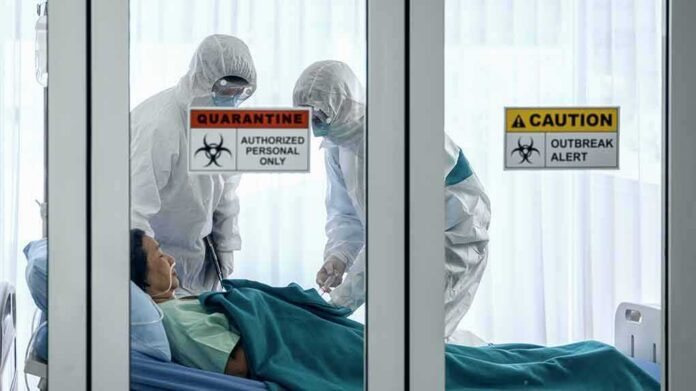
Kenya confirmed a third Ebola case, detected in quarantine and linked to the first patient who died, tightening the balance between control and concern.
Story Snapshot
- Kenya confirmed a third Ebola case in a quarantined contact of the first patient.
- Lab tests at two national facilities verified the infection, and the patient is in care.
- Health teams tracked 130 contacts; 127 were in quarantine with daily checks.
- Officials report no community spread, though three contacts were still untraced.
What Kenya Confirmed And How The Patient Was Found
Kenya’s Health Ministry reported a third Ebola case in a 65-year-old woman who was already in quarantine as a primary contact. Officials said she developed fever, sore throat, and malaise while under monitoring and was quickly isolated. The Ministry stated that she tested positive and was moved to an infectious disease unit for supportive care. Reuters reported that the case was diagnosed early due to quarantine checks, which lower exposure risk to the public.
The Ministry said the third case is epidemiologically linked to the first patient, who died on October 5. The World Health Organization reported that the second and third cases were close family members of the first patient. That linkage supports the government’s view that these detections reflect a contained cluster, not wider community transmission at this time. Health workers are continuing daily symptom checks of listed contacts to interrupt any further spread.
Laboratory Verification And Patient Care Steps
The Health Ministry said two Kenyan laboratories confirmed the positive result. Tests were completed at the National Virology Reference Laboratory and the Kenya Medical Research Institute laboratory. Using two facilities for confirmation follows standard practice for high-consequence pathogens. After confirmation, doctors transferred the patient to a specialized infectious disease unit. Officials described her treatment as supportive care, which focuses on fluids, symptom relief, and close observation while preventing further transmission.
Reuters reported that the patient’s early diagnosis came during routine checks in quarantine. Early detection can reduce the number of unprotected contacts and helps health staff act fast. This approach aligns with World Health Organization guidance to isolate any contact who develops illness and to monitor all contacts for 21 days after their last exposure. Kenya’s stated steps reflect that playbook in real time.
Contact Tracing, Quarantine Numbers, And Remaining Gaps
The World Health Organization said health teams identified 130 contacts tied to the first case. These include family members, friends, healthcare workers, and people who flew on the same plane. By October 16, officials reported 127 contacts were in quarantine under daily temperature and symptom checks for the full 21-day window. This structure aims to catch any new illness fast and cut off transmission before new chains start.
Africanews reported that three of the identified 130 contacts were not yet traced or in quarantine as of the same date. That shortfall highlights a small but real gap while authorities maintain that public risk is low. Health teams typically continue outreach to locate any missing contacts and confirm outcomes. Until that happens, officials will rely on daily monitoring of those already quarantined and prompt isolation of anyone who becomes ill.
Why This Cluster Matters Beyond Kenya’s Borders
Ebola outbreaks often follow a known pattern: a first case moves across regions, close family members fall ill, and teams rush to identify and monitor contacts. The World Health Organization says that Kenya’s second and third cases were found in that high-risk circle and discovered early in quarantine. That timing matters because it boosts the chance of containing the virus and avoiding community spread, if monitoring stays tight and complete.
Following the recent confirmation of a fatal imported #Ebola case in #Kenya involving a traveller who passed through #Uganda, @WHO has intensified technical support to national and district health authorities to strengthen preparedness and response efforts.⁰
In Kasese District… pic.twitter.com/3SJdb15VZw— WHO Uganda (@WHOUganda) October 15, 2026
For readers in the United States, this story is a reminder of how public health should work when speed and clarity matter. Health workers named contacts, enforced quarantine, and used clear rules to act on new symptoms. That is the same basic playbook Americans expect federal and state agencies to follow during any high-risk threat. The focus is simple and practical: find exposures fast, isolate illness early, and keep the public informed with verified steps and numbers.
Sources:
aljazeera.com, wftv.com, rmb.reuters.com, nation.africa