

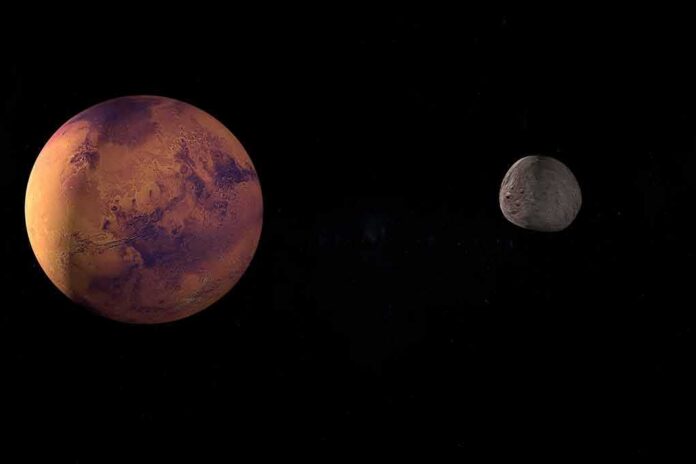
Japan is launching a mission to grab and bring home pieces of Mars’s moon Phobos, aiming for the first-ever sample return from the Martian system.
Story Highlights
- Japan’s Martian Moons eXploration will collect at least 10 grams from Phobos and return it to Earth.
- The spacecraft plans to reach Mars in 2027 and sample Phobos no earlier than late 2028.
- Japan leads; the United States, Europe, and France contribute instruments, support, and curation.
- The mission could reveal how Mars’s moons formed and what they are made of.
Japan Sets Sights on a Historic Sample Return
Japan’s space agency plans to launch the Martian Moons eXploration mission to land on Phobos and return a sample to Earth. The goal is clear and concrete: collect at least 10 grams of material from the surface and bring it home for lab study. The mission is billed as the world’s first sample-return effort from the Martian system. That is a technical leap that, if successful, will give scientists rare material shaped by Mars and the space around it.
Japan Aerospace Exploration Agency leads the mission design, operations, and sample return. Partners include the United States National Aeronautics and Space Administration, the European Space Agency, France’s space agency, and the German Aerospace Center. The plan divides work across agencies. The United States provides a gamma-ray and neutron spectrograph and other support. Europe adds rover work and mission support. Japan handles the spacecraft and return capsule.
What the Mission Will Do and When
The plan sets key steps on a tight clock. The spacecraft will cruise to Mars, arrive around August 2027, and begin close operations near Phobos. The team targets sampling no earlier than December 2028, then sends a return capsule back to Earth for delivery in 2031. The sampling system is mounted on a landing leg and is designed to pull in loose grains from the surface. That design aims to work in weak gravity and avoid a complex drill.
The science case centers on a long-running mystery. Scientists debate whether Phobos and Deimos are captured asteroids or debris from a giant impact on Mars. The mission will map the moons, read their elemental makeup, and test which origin story fits best. The returned grains will let labs measure isotopes, minerals, and organics at high detail. Those tests could also offer clues about Mars dust and how space weather shapes small bodies.
Instruments, Rover, and International Roles
The United States-built instrument called MEGANE will scan Phobos using gamma rays and neutrons to chart elements like iron, silicon, and hydrogen. That map will guide where to sample and how to read the results. Japan’s sampling system aims to gather material into a sealed capsule for the trip home. Europe and Japan also plan a small rover deployment to study the surface up close, adding context for the sample grains and surface hazards.
The partnership spreads cost and risk while pooling strengths. The United States will support communications through the Deep Space Network and will help curate a share of the returned material for research. Europe’s teams add landing and surface expertise, plus mission analysis support. France contributes to instruments and science planning. Japan’s leadership keeps the mission focused on the return goal and the strict handling steps to protect the sample.
Why This Matters Beyond Space Science
This mission shows how big goals still need careful teamwork and steady funding. Space sample returns are hard and often run into trouble, but they also produce knowledge that no telescope can match. Clear roles, public milestones, and open data can help taxpayers see value and hold leaders to results. If the plan stays on track, the samples could sharpen our picture of Mars’s past and guide safer, cheaper missions in the future.
NASA joins JAXA on the MMX mission! 🚀🔴 MEGANE and P-Sampler will study Mars' moons and return Phobos samples to Earth: https://t.co/M7aFVYLkyI#NASA #JAXA #MMX #Mars #SpaceExploration #Science #SpaceNews #Space
— AstroCurrent (@astrocurrentcom) October 16, 2026
One practical caveat applies: the dates are targets that depend on safe flight and operations. Even so, the mission has a defined path, tested tools, and named partners. That structure gives the public a way to follow progress step by step. Success would mark a first for the Martian system and a win for open, international science in a time when many feel large projects drift or overpromise.
Sources:
newscientist.com, mmx.jaxa.jp, science.nasa.gov, esa.int, dlr.de, cnes.fr