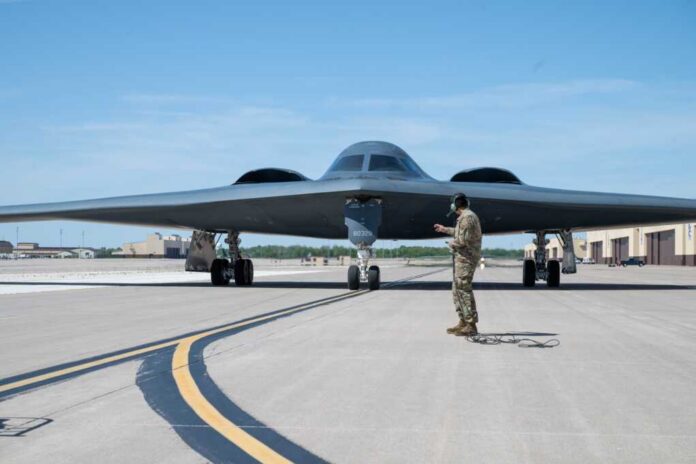
Chinese researchers claim they’ve discovered critical design flaws in America’s most advanced stealth bomber using nothing more than publicly available photos and simulation software—a brazen assertion that exposes either genuine vulnerabilities or Beijing’s latest round of aerospace propaganda.
Story Snapshot
- China’s aerodynamics center published peer-reviewed study claiming 15% aerodynamic improvements possible for B-21 Raider using simulation software PADJ-X
- Analysis based entirely on public imagery without access to classified design data, stealth coatings, or internal systems
- Chinese track record includes overhyped claims like JY-27 anti-stealth radars that failed real-world testing
- B-21 program continues on schedule with $203 billion at stake and 100-plus aircraft planned for Pacific operations against China
Beijing’s Simulation Claims Target America’s Stealth Edge
Researchers from China’s Aerodynamics Research and Development Centre published findings in December 2025 asserting their PADJ-X software identified aerodynamic and stability limitations in the U.S. Air Force’s B-21 Raider. Lead researcher Huang Jiangtao claimed simulations showed potential for a 15% increase in lift-to-drag ratio and stabilized pitching moments. The peer-reviewed paper in Acta Aeronautica et Astronautica Sinica marks Beijing’s latest attempt to demonstrate aerospace competitiveness against American military superiority. This theoretical exercise relies entirely on adjoint optimization applied to publicly available images, lacking access to classified specifications that define the bomber’s true capabilities.
B-21 Raider Stealth Bomber Problem? China’s ‘Mad Scientists’ Think They Found a Flawhttps://t.co/VXegfdtxAH
— 19FortyFive (@19_forty_five) January 28, 2026
Limited Analysis Excludes Critical Stealth Technologies
The Chinese study’s fundamental weakness lies in what researchers couldn’t analyze. PADJ-X simulations excluded radar-absorbent materials, internal weapons bays, electronic warfare systems, and classified aerodynamic features that constitute the B-21’s actual stealth advantage. Northrop Grumman and the Air Force invested $25.1 billion in development precisely to refine these elements through real-world testing at Edwards Air Force Base, where the second test aircraft arrived in September 2025 for weapons integration. China’s reliance on open-source intelligence for asymmetric analysis demonstrates desperation to close the gap, but simulation software cannot replicate the decades of classified research embedded in America’s sixth-generation bomber design.
China’s History of Overhyped Military Claims
Beijing’s aerospace announcements deserve skepticism given past performance failures. Chinese officials previously touted JY-27 anti-stealth radars as game-changing technology, yet these systems underperformed dramatically in Venezuelan operations and real-world scenarios. The PADJ-X claims follow this pattern—impressive on paper but unproven in hardware applications. While the peer-reviewed publication adds academic credibility, it cannot overcome the reality that American stealth programs like the B-2 and F-22 faced similar early critiques from simulation and wind-tunnel analysis, only to succeed through classified iterations. China’s multidisciplinary optimization tool may accelerate their own designs like the H-20 bomber, but claiming to identify flaws in an operational American aircraft from photographs stretches credibility beyond reason.
Strategic Implications for Pacific Dominance
The B-21 Raider represents America’s answer to Chinese military expansion, designed specifically for long-range strikes from U.S. bases against targets in the Pacific theater. The Air Force plans initial operational capability by the mid-to-late 2020s with 100 to 200-plus aircraft at approximately $700 million per unit. Heritage Foundation analysts urge accelerated production to 225 units, arguing the bomber’s networked capabilities matter more than pure aerodynamics. China’s PADJ-X publicity stunt may serve domestic propaganda purposes, but it also reveals Beijing’s anxiety about American air superiority. The $203 billion program continues unaffected by theoretical Chinese simulations, with testing expanding at Edwards to validate systems no amount of adjoint optimization can compromise from afar.
This episode underscores the enduring value of classified development programs that shield American technological advantages from rival analysis. While China pursues simulation-driven shortcuts to reduce wind tunnel and prototype costs, the United States maintains its edge through comprehensive testing that integrates materials science, electronic warfare, and operational doctrine. The Air Force has issued no official rebuttal to PADJ-X claims, likely recognizing that classified capabilities speak louder than theoretical models built on incomplete data. As U.S.-China tensions escalate, the B-21’s real test will come not from Chinese software but from its demonstrated ability to penetrate advanced air defenses and project American power across the Pacific—a mission no simulation can adequately predict or counter.
Sources:
B-21 Raider Stealth Bomber Problem? China’s ‘Mad Scientists’ Think They Found a Flaw – 19FortyFive
Design Flaws in B-21 Raider? China Claims Its Software Exposed Weaknesses – EurAsian Times
China’s Stealth Design Software PADJ-X Finds Potential Flaws in B-21 Bomber Configuration – South China Morning Post
Chinese Study Claims US B-21 Stealth Bomber Design Has Issues – Interesting Engineering
B-21 Raider: The Stealth Bomber the Air Force Needs Right Now – Heritage Foundation
B-21 Raider Could See First Deployment Next Year. China Isn’t Happy – The National Interest