Ships are still crossing the Strait of Hormuz — but the numbers tell a story of a waterway on life support, with Iran demanding permission to pass and the U.S. military enforcing its own rules at the same time.
Story Snapshot
- Ship traffic through the Strait of Hormuz has dropped more than 94% since the conflict began, falling from roughly 138 vessels per day to just 3.
- Some ships are still getting through — 99 crossed in March, and 172 made it through after a U.S.-Iran ceasefire on April 8 — but traffic remains far below normal.
- Iran’s Islamic Revolutionary Guard Corps is warning ships they must get permission before crossing, threatening to target any vessel that doesn’t comply.
- Both the U.S. and Iran are now claiming authority over the strait, leaving ship captains caught between two sets of rules — with no clear safe path forward.
Traffic Has Collapsed — But Not Completely Stopped
Before the conflict, about 138 ships passed through the Strait of Hormuz every day. That number has fallen off a cliff. Data from maritime tracking firm Kpler shows traffic is down more than 94%, with only around three vessels crossing per day. At least 200 ships are anchored outside the strait, unable to reach port. The UK Maritime Trade Operations Center has labeled the risk level “critical.” The economic impact is enormous — the strait carries roughly 20% of the world’s oil supply.
Despite the danger, some ships are still making the crossing. BBC Verify counted 99 ships that passed through in March alone, averaging five to six per day. After a U.S.-Iran ceasefire took effect on April 8, Kpler recorded 172 crossings — including 42 on a single Saturday. Following a memorandum of understanding signed on June 17, marine intelligence firm AXSMarine reported 25 commercial vessels crossed on one Thursday, the highest single-day count since April. These numbers confirm the strait is not completely sealed — but they are a fraction of what used to be normal.
Iran and the U.S. Are Both Claiming Control
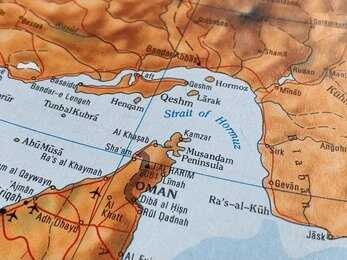
Iran’s Islamic Revolutionary Guard Corps has issued direct warnings to ships in the Persian Gulf and Gulf of Oman. In a recorded English-language message obtained by the Wall Street Journal, the Guard warned that any vessel deviating from designated routes or crossing without permission “will be targeted.” Iran says the only approved route runs along the Iranian coast, between Larak Island and the mainland. It has called all other routes “unacceptable and extremely dangerous.” Six Iranian oil tankers were turned back by a U.S. naval blockade, showing that enforcement is real on both sides.
The U.S. military is enforcing its own rules. U.S. Central Command (CENTCOM) issued a blockade order on April 10 barring vessels from entering Iranian ports. At the same time, CENTCOM has stated publicly that the strait remains open for transit — directly contradicting Iran’s closure declaration. Ships are now caught between two authorities. Iran says get our permission or face attack. The U.S. says the waterway is open, but don’t go to Iranian ports. For a ship captain trying to move cargo, neither answer is reassuring.
What This Means for Energy Prices and Everyday Americans
The Strait of Hormuz is not just a foreign policy problem — it hits Americans at home. When oil can’t move freely through the strait, global supply tightens and prices rise. Oil futures jumped more than 3% in a single weekend as markets reacted to renewed U.S. strikes and fresh threats to shipping. Higher oil prices mean higher gas prices, higher heating costs, and higher prices on goods that depend on fuel to be shipped. Every day the strait stays in crisis, ordinary Americans pay more.
🚢 Strait of Hormuz vessel traffic drops over 50% amid renewed attacks
📍 Commercial crossings fall about 52% between July 10 and 12 near strategic waterway, as ships shift to perceived safer routes, MarineTraffic says
— Markets Today (@marketsday) July 13, 2026
The broader frustration here is familiar. Two governments — one in Washington, one in Tehran — are fighting for control of a waterway that the world depends on. Meanwhile, hundreds of ships sit idle, cargo goes undelivered, and energy markets stay on edge. The people who built those ships, crew them, and depend on the goods they carry have no say in any of it. Whether you blame U.S. military policy or Iranian aggression, the result is the same: the system that moves the world’s energy is broken, and regular people are paying the price.
Sources:
insiderpaper.com, hormuztracking.com, reuters.com, bbc.com, statista.com, nytimes.com, theguardian.com, gulfnews.com