President Trump’s decision to leave his brand-new Air Force One in Europe after the NATO summit, while flying home on the old jet, has raised fresh questions about security, symbolism, and who really controls America’s leaders.
Story Snapshot
- Trump left the new Air Force One in Europe and flew home on the older aircraft, sparking speculation.
- He says the move was to let U.S. troops and allies tour the new plane, not because of fear.
- Trump also claims he is Iran’s “number one” assassination target, even as officials stress there is no proof Iran targeted the jet.
- The episode feeds wider public concern that security decisions and messaging are shaped by elites, not ordinary Americans.
Trump’s NATO Trip And The Airplane Switch
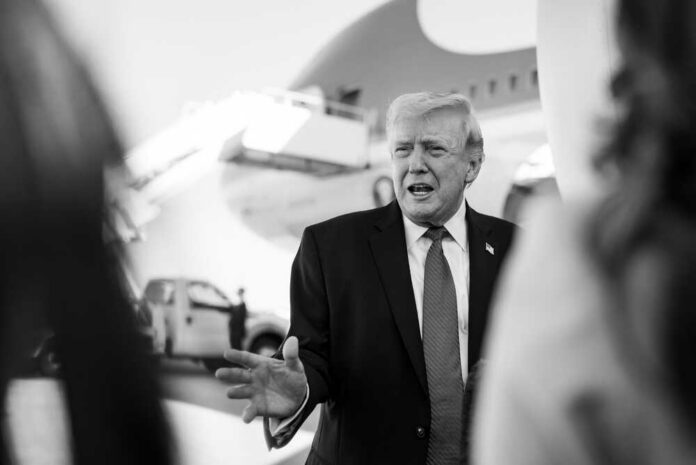
President Donald Trump traveled to Ankara, Turkey, for a high-profile NATO summit using the newly refurbished presidential jet often called the new Air Force One. After the meetings, cameras caught the new aircraft departing Turkey without Trump on board, while he instead boarded the older VC-25A Air Force One to return toward Joint Base Andrews in Maryland. This unusual split flight pattern quickly sparked questions in U.S. media and online about why a president would avoid his own newest, most secure plane.
Reporters and commentators noted that presidents normally use the same official aircraft for both legs of major trips, especially during tense global moments. Video clips from the Ankara airport showed the new jet taking off separately, heading toward Europe, while Trump spoke briefly with staff before boarding the older aircraft. The optics fed both right and left wing worries about transparency and the level of control presidents truly have over their own security and travel plans.
What Trump Says About Iran And His Security Risks
During his broader public comments on Iran in recent years, Trump has claimed that Iranian leaders put him at the top of a “kill list” and view him as their “number one target.” A report in The Independent said his campaign team feared Iran could try to shoot down his plane after intelligence suggested a plot against him, adding to worries about surface-to-air missiles in hostile hands. An article in The Jerusalem Post likewise described security officials warning that Tehran had access to missiles that could threaten Trump’s private jet.
These claims fit into a long pattern where leaders cite foreign threats to explain extra caution around flights and motorcades. Aviation security experts say governments often take more protective steps when tensions rise, even when they do not share detailed threat information with the public. At the same time, media outlets covering Trump’s NATO travel stressed that they had found “no evidence” Iran was involved in any technical issue or route change affecting Air Force One during this summit, treating the extra caution as precaution rather than proof of a plot.
Trump’s Public Explanation: Showing Off The New Plane
In a Fox News interview, Trump pushed back on talk that he was dodging the new plane out of fear, and instead framed the decision as a way to support American troops. He said the refurbished aircraft was flying “to Europe, to one of the big bases” and then to “two or three of the big bases where we can show it to the people,” including soldiers stationed far from home. Trump added that he would be “going home by normal methods,” meaning the older Air Force One that has carried presidents for decades.
Earlier, Trump had publicly unveiled the Qatar-donated jet at Joint Base Andrews, posing in front of it and linking the display to U.S. power and ongoing tensions with Iran. Coverage by outlets such as PBS and ABC News showed him praising the plane’s range and comfort while also arguing that strong military hardware sends a message to rivals. Those events framed the new Air Force One as both a symbol of American strength and a gift tied to complex global relationships, which already made some Americans uneasy about foreign influence and defense industry interests.
Media Skepticism And The Deep State Feeling
Major news organizations like NBC News and others highlighted that there was “no evidence” Iran had anything to do with the plane’s routing or any minor electrical issue linked to earlier trips. A popular YouTube breakdown of the situation repeated that there was “no evidence that Iran had anything to do with the Air Force One issue,” challenging claims that the aircraft swap showed a direct, immediate threat. This emphasis on the official line—that the decision was routine and precautionary—echoes past coverage where media often dismiss more alarming interpretations unless backed by documents.
US President Donald Trump departed Ankara aboard Air Force One after attending the NATO summit in Turkey. Before leaving, Trump waved goodbye from the aircraft's doorway as Air Force One taxied down the runway and took off, bringing his visit to Turkey to a close.#Trump #NATO… pic.twitter.com/Xyr7f1vC76
— APT News (@APT__News) July 8, 2026
For many Americans, especially those who distrust Washington, this only deepens a sense of confusion and anger. Conservatives see years of downplayed security threats and foreign entanglements, while liberals see leaders using fear and military theatrics instead of fixing basic problems at home. Both sides share a growing belief that the “deep state” and other elites control the story, whether by keeping threat details secret or by steering public attention away from possible risks and conflicts of interest around a $400 million presidential jet.
What This Says About Power, Security, And Trust
Experts on aviation security note that flight plans for high-profile figures often change for reasons the public never hears, from technical checks to updated threat assessments. They also explain that unpredictability in how leaders travel—changing aircraft, routes, or timing—can be a tool to keep enemies guessing. This means Trump’s choice to send the new Air Force One one way while he flew another can be read as either a smart security tactic, a simple public relations move, or a mix of both.
The deeper problem is that Americans have little way to verify which explanation is true. There are no public security briefings that fully confirm or deny Iranian plots against Trump’s aircraft during this summit period. There are no open technical reports yet on any electrical issues tied to the new plane. In that vacuum, trust depends on faith in institutions many voters on both left and right no longer share. So a single flight choice—new plane one direction, old plane another—becomes one more sign, for millions, that the system serves the powerful first and the public last.
Sources:
youtube.com, the-independent.com, axios.com, thehill.com, cbsnews.com, facebook.com, bbc.com, abcnews.com, georgewbush-whitehouse.archives.gov, faa.gov