Americans now wager more money on sports than they spend on movies, music, books, and museums combined — and that should make both fans and taxpayers stop and think.
Story Snapshot
- Americans legally bet about $166 billion on sports in 2025, an 11% jump from 2024.
- Sports betting has exploded since a 2018 Supreme Court ruling let states legalize it, turning games into a giant gambling market.
- States now collect billions in tax revenue from betting, even as research shows sharp rises in gambling addiction and financial stress.
- Sports betting apps are becoming a normal part of daily life, raising new worries about debt, mental health, and the power of big gambling companies.
Sports Betting Jumps to the Top Tier of American Entertainment
In 2025, Americans placed roughly $166 billion in legal sports bets, according to American Gaming Association data reported by major outlets. That total handle, or money wagered, grew about 11% from 2024’s record near $150 billion. One Fortune analysis found this betting figure is now larger than what Americans spend on movies, music, books, and museums put together, showing how central gambling has become to everyday entertainment. Sports betting is no longer a side hobby; it is now a core way millions choose to have fun and spend extra cash.
Industry numbers show not only big wagers but rising profits. Sportsbooks kept about $16.96 billion of that 2025 handle as revenue, an increase of more than 20% from the year before. The national “hold” rate — the share of bets that operators kept — climbed to around 10%, meaning companies are earning more per dollar wagered than in the past. These figures place sports betting alongside major entertainment and tech businesses in scale, even though the product is simple: risk money on scores, stats, and outcomes, often with a tap on a phone.
How a Court Ruling Turned Games into a Gambling Gold Rush
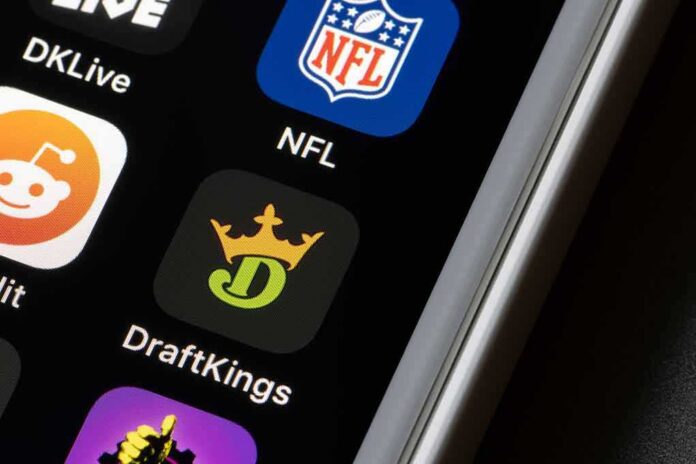
The current boom traces back to a 2018 Supreme Court decision that struck down a federal ban on most sports gambling and let states decide for themselves. Since that ruling, roughly three dozen states plus Washington, D.C., and Puerto Rico have legalized sports betting in some form, many allowing online wagering. This state-by-state rollout opened a huge new market and drew in national brands like DraftKings and FanDuel, who built sleek apps that make betting feel like a normal part of watching the game. The result is a fast-growing digital industry sitting on top of America’s long love of sports.
Growth has been stunning in a short time. Americans wagered about $6–7 billion on legal sports bets in 2018; by 2025, that number had surged to well over $160 billion, a more than twenty-fold jump. Analysts at Insider Intelligence and other firms say total spending passed $100 billion by 2023 and is still rising by double digits each year. Market research groups now project that U.S. sports betting revenue could roughly double again by the early 2030s, assuming more states legalize and more people sign up for apps. For both fans and critics, this is not a small trend; it is a major shift in how entertainment and risk mix in American life.
States Cash In While Households Shoulder the Risk
State governments have turned sports betting into a new tax pipeline. Census Bureau data show state tax revenue from sports betting jumped from about $190 million in late 2021 to $917 million by mid‑2025, a rise of more than 300% in less than four years. Industry trackers estimate total state betting taxes around $3.7 billion in 2025, reflecting how lawmakers now depend on this money to help fill budget gaps without raising income or sales taxes directly. Many politicians sell betting as “fun money” that supports schools, roads, or public programs.
At the same time, families and individual bettors bear the losses. Gross gaming revenue — the amount operators keep after paying winners — reached nearly $17 billion in 2025. That money comes from countless small and medium-size losses, often on easy-to-place bets like same-game parlays pushed during big events. For a federal government already criticized for favoring corporate interests, this model can feel like another example: companies and states profit while many households quietly lose money, sometimes money they need for savings, retirement, or paying down debt.
Rising Addiction, Financial Strain, and Public Concern
Health researchers and nonprofit groups warn that the sports betting boom is bringing serious side effects. A study in JAMA Internal Medicine found a sharp increase in people seeking help for gambling addiction after the legalization wave, linking the change to easier access and constant ads. Harvard-affiliated experts describe “skyrocketing” wagers and note special risk for young men, who are heavily targeted by betting promotions and often view gambling as part of sports culture. These trends match the growing concern many Americans already feel about debt, stress, and mental health.
Sports betting is becoming one of America's biggest forms of entertainment.
Americans placed roughly $166 billion in sports bets in 2025, more than the U.S. movie, music, book, and museum industries generated in revenue combined, according to a new report.
Those four industries… pic.twitter.com/LnoW2pi41y
— FOX Business (@FoxBusiness) July 28, 2026
Surveys suggest the public is starting to push back. Pew Research Center found that while about 22% of adults bet on sports in the past year, more Americans now say legal sports betting is bad for society and for sports than say it is good. Other polling shows that more than a quarter of Americans already have an active online sports betting account, turning what used to be a casino-only habit into something people carry in their pockets every day. For citizens on both the left and the right who worry that powerful industries and government regulators are ignoring long‑term harm, sports betting looks like one more example of profit-first policy where ordinary people become the “house edge.”
Sources:
pbs.org, npr.org, today.ucsd.edu, youtube.com, marketplace.org, cnn.com, radaronline.com, rg.org, pewresearch.org, pmc.ncbi.nlm.nih.gov, fortune.com, grandviewresearch.com, espn.com, americangaming.org, finance.yahoo.com, emarketer.com, goldmansachs.com, linkedin.com