
When Irish police stopped a single car on a rural road in County Monaghan and found a fully assembled, “extremely significant” bomb inside, they did more than avert a potential atrocity—they exposed how a small but determined dissident network still tries to turn the invisible Irish border into a fault line of lethal risk.
Key Points
- An intelligence-led Garda operation intercepted a car near Carrickmacross, County Monaghan, carrying a fully constructed, “extremely significant” explosive device close to the Northern Ireland border.
- The bomb is described by senior police and media sources as sophisticated, using suspected military‑grade explosives, and capable of causing serious damage and major disruption if it had detonated.
- A woman in her 20s driving the vehicle and a man in his 40s were arrested on suspicion of state‑related offences in an investigation targeting dissident republican activity.
- The case fits a long pattern: sporadic but serious attempts by dissident republicans to mount cross‑border attacks, matched by increasingly integrated Irish–UK counter‑terrorism cooperation.
What Gardaí Say They Stopped Near the Border
The core facts of the incident are not in dispute. In an operation described by Gardaí as intelligence‑led, specialist detectives stopped a car on the N2 south of Carrickmacross, in County Monaghan, roughly ten kilometres from the open border with Northern Ireland. Inside the vehicle they found what Garda Commissioner Justin Kelly later called “an extremely significant seizure… an explosive device,” stressing that officers had intercepted a functioning bomb rather than loose components.
Because of the suspected scale and sophistication of the device, Gardaí immediately requested support from the Irish Army’s Explosive Ordnance Disposal (EOD) unit. The bomb was made safe on site and removed for forensic examination, a standard routine whenever authorities believe they have recovered a viable improvised explosive device (IED). Officials have declined to release full technical details “for operational reasons,” but both police briefings and follow‑up reporting converge on the same description: this was a constructed car bomb, in transit, stopped just short of the border and linked to suspected dissident republican activity.
The Device: From “Highly Significant” to “Military‑Grade”
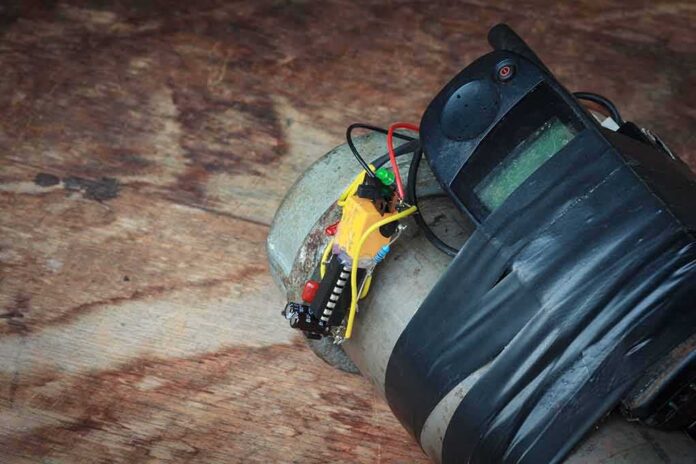
Public statements and informed reporting suggest the bomb combined a power unit, detonator, and high‑performance explosives into a ready‑to‑use device. The Commissioner’s emphasis that this was “certainly not just the seizure of components or pieces” aligns with accounts that the bomb was already built and could have caused “significant damage” had it detonated. Media with Garda sources have gone further, describing the explosives as “suspected military grade” and the device itself as “highly sophisticated” and “advanced.”
In modern Irish and UK security practice, language like “highly significant” and “military grade” is carefully chosen. It points toward energetic materials such as SEMTEX or similar plastic explosives, originally developed for military use, prized by paramilitary groups for their stability and destructive power. These materials can be shaped into compact charges capable of shattering structural elements or turning an ordinary vehicle into a large, mobile weapon. While the exact formulation in this case remains classified, the decision to deploy the Army’s EOD specialists, the distance from the border, and the Commissioner’s stress on the seizure’s significance all support the conclusion that this was a bomb built for real-world deployment, not experimental tinkering.
Who Was Arrested and What They Are Suspected Of
Two arrests followed swiftly. The driver, a woman in her 20s, was taken into custody at the roadside on suspicion of offences against the state and remained detained as investigators assembled evidence and sought legal advice. A second suspect, a man in his 40s, was later arrested in the Dublin area in connection with the same operation. Subsequent reporting has identified the younger suspect as a trainee solicitor and the older man as allegedly linked to a dissident republican structure in Dublin, though formal charges and any eventual trial will determine how those characterisations hold up.
The Garda operation was explicitly framed as targeting dissident republicans—groups that reject the Good Friday Agreement, have not decommissioned weapons, and seek to continue an armed campaign, particularly against police and security services. That framing is consistent with the history of similar border‑area plots, where devices have been aimed at Police Service of Northern Ireland (PSNI) officers, army patrols, or symbolic targets associated with British authority.
Dissident Republican Activity Since the Good Friday Agreement
To understand why Irish police treated one intercepted car bomb as a major national security event, you have to place it in the longer arc of post‑agreement violence. The 1998 Good Friday Agreement dramatically reduced large‑scale terrorist attacks, but it did not extinguish militant republicanism. A handful of organisations, including the so‑called New IRA and Continuity IRA, have maintained or rebuilt armed capabilities, drawing on hidden explosives caches, black‑market supply, and incremental technical learning.
Irish and Northern Irish authorities have repeatedly warned that dissident paramilitaries are becoming “increasingly skilled at making bombs,” displaying seized weapons ranging from beer‑keg devices and mortars to assault rifles and bulk explosives. Earlier plots near the border—such as the 600‑lb bomb at Newry described by police as showing “destructive, murderous intent” or the complex under‑car bomb planted beneath a PSNI officer’s vehicle in Belfast—demonstrate the capacity for both large‑scale and precision attacks. Against that backdrop, a fully assembled car bomb heading toward the border is not an anomaly; it is the latest visible node in a low‑intensity but persistent campaign.
The Cross‑Border Dimension: An Open Border, Shared Threat
The geography of this case matters. The car was stopped in County Monaghan, close to an open, unfortified border with Northern Ireland—an arrangement central to the peace settlement and everyday life on both sides. For dissident groups, that same openness is an operational opportunity: they can move people and materiel with fewer visual cues of jurisdictional change, complicating surveillance and response.
Authorities have responded by tightening cooperation rather than hardening the border itself. Gardaí routinely stress their close working relationships with the PSNI and UK intelligence services, and recent incidents have triggered joint investigations, shared forensic work, and cross‑jurisdiction arrests. In this case, while officials have withheld the intended target, they have been clear that the bomb was believed to be bound for Northern Ireland, underscoring that a plot conceived on one side of the border can have its intended victims on the other.
Why Official Threat Language Often Outruns Public Forensics
One recurrent feature of security reporting in Ireland and Northern Ireland is the gap between early official descriptions and the technical detail eventually shared. Police and ministers will describe a device as “serious,” “sophisticated,” or “potentially devastating” well before public forensics catch up. That pattern is visible here: the Commissioner’s “extremely significant” formulation landed within days, while specifics about explosive type, fusing, and intended deployment remain closely held.
The reasons are practical as much as political. Detailed disclosure can reveal investigative methods, compromise informants, or teach would‑be bomb‑makers what worked and what did not. At the same time, authorities need to communicate the gravity of the threat to justify extraordinary powers and reassure the public that real dangers are being addressed. In this case, the convergence of multiple outlets, the deployment of the Army EOD unit, and the recovery of a built device near a historically sensitive border together make the official language proportionate to the evidence available.
Small Numbers, High Stakes: The Ongoing Security Challenge
One of the paradoxes of dissident republican violence today is scale. Gardaí and PSNI repeatedly characterise these militants as a “small minority” in numerical terms, far removed from the mass‑membership organisations of the Troubles era. Yet their ability to assemble bombs, recruit young couriers, and exploit cross‑border movement gives them a disproportionate capacity to disrupt. A single device, if successfully detonated, can produce casualties, dominate news cycles, and strain political relationships around sensitive issues such as legacy, policing, and constitutional futures.
The Monaghan interception illustrates that double reality clearly. On one side: two suspects, one vehicle, one bomb. On the other: a joint intelligence effort, deployment of specialist units, political scrutiny in Dublin, Belfast, and London, and renewed questions about how close a “small minority” came to staging a high‑impact attack. For security planners, it is a reminder that in a landscape where overall violence is far lower than in the 1970s or 1980s, risk is now concentrated in fewer but potentially sharper spikes.
An "extremely significant" car bomb has been intercepted by Irish police near the border with Northern Ireland.
A female driver in her 20s has been arrested after Irish police discovered the explosive during an operation targeting "dissident republicans".
The device was found… pic.twitter.com/pS1ZFJGQxz
— World Source News (@Worldsource24) July 24, 2026
What This Means Going Forward
The immediate consequence of the Monaghan case is operational: two suspects in custody, a bomb destroyed, and a chain of physical and digital evidence now being analysed to map who built the device, who moved it, and who—if anyone—ordered its deployment. But the deeper implications lie in how states manage fragile peace. The incident confirms that the Good Friday Agreement did not mark an absolute end to militant violence; it changed its scale, frequency, and political support, but not its underlying possibility.
For Irish and UK authorities, that means sustained investment in intelligence, forensic capacity, and joint working arrangements that treat the border not as a wall but as a shared zone of responsibility. For citizens, it is a reminder that the “normalisation” of everyday life in border counties sits atop security work that mostly remains invisible—until, as in this case, a single car is pulled over and an “extremely significant” bomb is quietly removed from the road.
Sources:
insiderpaper.com, euronews.com, reuters.com, bbc.com, news.sky.com, washingtonpost.com, theguardian.com, thedefensepost.com, dw.com, bbc.co.uk