

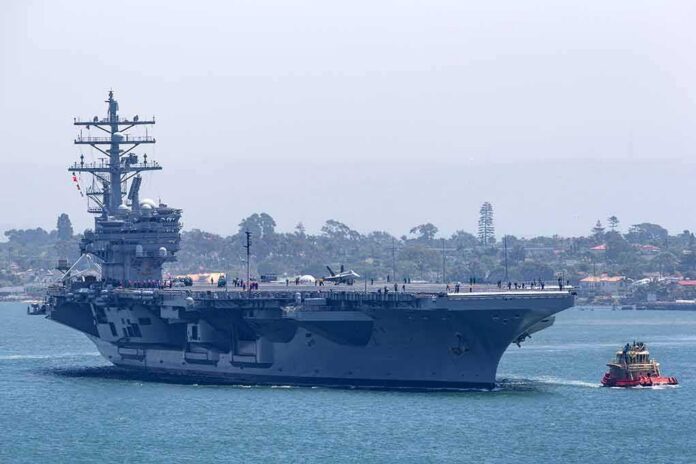
When the United States sustains air and maritime strikes against Iran for nearly two weeks straight, it is not just responding to individual attacks on ships; it is testing, in real time, how far a modern power will go to enforce freedom of navigation through one of the world’s most strategically fragile waterways.
Key Points
- U.S. Central Command (CENTCOM) frames the 12‑night strike campaign as a focused effort to degrade Iran’s ability to attack commercial vessels and civilian mariners in and around the Strait of Hormuz.
- The targets described publicly are overwhelmingly military or dual‑use systems: coastal surveillance, air defenses, missile and drone sites, naval assets, command centers, and logistics nodes.
- The campaign is clearly sustained and escalatory—running for at least 12 consecutive nights and paired with a renewed maritime blockade and diversion of commercial shipping.
- Independent reporting confirms real casualties and damage inside Iran, but there is still no publicly available forensic evidence tying each struck site to specific attacks on individual ships.
- The operation fits a long‑running pattern in U.S.–Iran crises: Washington presents strikes as defensive and limited, while critics question attribution, legality, civilian impact, and whether the narrow maritime rationale has expanded into broader coercive war‑making.
From One‑Off Response to a Twelve‑Night Campaign
By the time CENTCOM announced strikes on Iran for the 12th consecutive night, the operation had clearly moved beyond a single, discrete reprisal. The command’s own statements describe a sequence of nightly missions beginning in early July, characterized as “new rounds” or “additional rounds” of strikes designed “to further degrade Iran’s ability to attack commercial shipping and innocent civilian mariners in the Strait of Hormuz.” Reuters and other outlets trace the opening salvo to July 7, when U.S. forces hit more than 80 targets in response to what Washington said were Iranian attacks on three commercial vessels transiting the Strait.
From there, the tempo increased. Within days, CENTCOM and press reports were citing roughly 90 targets hit in one wave, then about 140 in another, with an emphasis on coastal radar, anti‑ship missile capabilities, air defense systems, and Islamic Revolutionary Guard Corps (IRGC) small boats near the strait. The twelfth night of strikes—announced in late July—continued that pattern, stressing that the mission “will continue to further degrade Iran’s ability to threaten civilian mariners and commercial vessels transiting regional waters.” This language matters: it signals intent to sustain operations until the perceived threat to shipping lanes is substantially reduced, not merely punished.
What the United States Says It Is Targeting—and Why
Across multiple statements and news accounts, the U.S. military presents a remarkably consistent picture of its target set. CENTCOM describes hitting “Iranian military targets including maritime capabilities, missile and drone storage facilities, coastal surveillance sites, and air defense assets,” along Iran’s coastline and in key port areas such as Bandar Abbas. Earlier rounds focused on air defense systems, command‑and‑control networks, coastal radar, and more than 60 IRGC small boats “in and near the strait (of Hormuz),” explicitly framed as degrading Iran’s ability to continue attacking international commerce through the corridor.
The justification is equally consistent. CENTCOM repeatedly links each wave of strikes to recent incidents against commercial shipping—tankers hit or threatened by Iranian forces in the Strait of Hormuz—and couches the operation as self‑defense and freedom‑of‑navigation enforcement. In an NPR account, U.S. officials connect a fresh round of strikes to a specific attack on a commercial ship, then describe hitting air defenses, coastal radar, missile and drone capabilities, and small boats as a way to “continue degrading their ability to attack civilian mariners and commercial ships freely transiting the Strait of Hormuz.”
Mechanically, this is classic capability‑degradation targeting. Radar and coastal surveillance help locate and track ships; anti‑ship missiles, armed drones, and small fast attack craft provide the means to strike them; command centers and communications networks coordinate those assets; logistics nodes keep them supplied and operational. By going after all layers of that system in a compressed time frame, the United States is attempting to break not just individual launch platforms but the integrated architecture Iran uses to threaten shipping.
Escalation: Naval Blockade and Wider Conflict Footprint
At the same time, the pattern of operations and parallel measures makes clear that this is not a narrowly tailored response existing in isolation from broader coercive pressure. During the same window that strikes were conducted on land, Washington resumed a maritime blockade of Iranian ports, redirecting commercial vessels and disabling at least one ship that attempted to run the blockade. CNN and other outlets report that the blockade took formal effect at a specific hour and applied to vessels traveling to and from Iranian ports, a significant escalation in economic and military pressure beyond the targeting of missile sites or radar stations.
Iran, for its part, did not absorb the blows passively. Reuters describes Iranian attacks on U.S. military infrastructure in Gulf states and continued incidents in the Strait of Hormuz after U.S. strikes, underscoring a reciprocal cycle of action and retaliation rather than a one‑sided policing operation. Casualty figures reported by Iranian state media—14 killed and 78 wounded across several provinces early in the campaign—illustrate that, whatever the target categories, the effects inside Iran are tangible and lethal. In short, by night twelve, the operation looks less like a surgical defense of shipping and more like a theater‑wide contest over who sets the rules of the Gulf.
Military Versus Civilian Targets: What We Know and What We Don’t
On paper, the strike list is firmly in the military domain: air defenses, coastal surveillance, missile and drone facilities, naval capabilities, command centers, and logistics infrastructure. Multiple independent outlets, from Reuters to public broadcasters, quote CENTCOM’s descriptions of these targets and do not present evidence that obviously civilian sites—hospitals, residential complexes, pure commercial facilities—were systematically struck. This lends some support to the U.S. claim that the campaign is directed at genuine threat‑enabling capabilities.
Yet the evidentiary record available to the public is narrow. It relies heavily on CENTCOM statements and press‑pool reporting; it does not include commercial satellite analyses of each site hit, detailed battle‑damage assessments, or independent forensic work tying specific coastal installations to particular attacks on named ships. Some accounts introduce ambiguity: one report notes that among the targets were telecom towers “that could be used for drones,” raising questions about whether certain dual‑use infrastructure—supporting both civilian communications and military operations—was attacked. Without granular verification, that line between military and civilian, or single‑use and dual‑use, remains partly inferred.
Equally important, there is no public dataset yet showing whether the campaign has measurably reduced attacks on shipping: no before‑and‑after tally of missile launches against tankers, attempted hijackings, or AIS (Automatic Identification System) disruption patterns in the Strait. The United States asserts intent—degrading Iran’s ability to attack vessels—and describes destroyed platforms. It has not, in open sources, demonstrated outcome.
Legality, Attribution, and the Recurrent Strait of Hormuz Pattern
The legal and political debate around such operations tends to crystallize around three questions: attribution (did Iran actually conduct the attacks cited?), necessity and proportionality (were the strikes the minimum force required to halt those attacks?), and authorization (under what domestic and international legal authorities are the strikes carried out?). In this case, official U.S. statements and mainstream reporting foreground attribution and necessity claims but offer very little in terms of detailed legal exposition.
CENTCOM and the Pentagon assert that Iran attacked three commercial vessels in the Strait and that strikes are an immediate, defensive response designed to impose costs and prevent further assaults. They do not, in public, provide shipboard forensic data, intercepted communications, or intelligence assessments that would allow outside observers to scrutinize that attribution. Nor do the sources provided include War Powers notifications, Office of Legal Counsel opinions, or explicit proportionality analyses that would answer sovereignty‑violation concerns under international law.
This pattern is familiar. For decades, episodes of maritime sabotage and tanker attacks in or near the Strait of Hormuz have triggered U.S. responses framed as “limited defensive strikes” against radar, missile batteries, and fast boats, while Iranian officials and sympathetic analysts contest both the narrative of Iranian culpability and the legality of strikes inside Iran’s territory. The 2026 campaign squares with that base rate: Washington’s public case emphasizes commercial vessels and civilian mariners; critics focus on escalation, casualties, and the lack of transparent, granular evidence.
Strategic Logic: Degrading Capability Versus Deterrence Failure
Seen through a military‑strategic lens, the decision to conduct twelve consecutive nights of strikes plus a blockade reflects a judgment that modest, symbolic action would not suffice to alter Iran’s risk calculus. By hammering multiple layers of Iran’s coastal and maritime strike complex—sensors, shooters, command systems, and the small‑boat fleet—Washington is attempting to raise the operational cost of harassment or attack so high that Tehran refrains from targeting tankers, at least for a time.
The history of similar campaigns suggests mixed prospects. Capability‑degradation can temporarily reduce the volume or sophistication of attacks, but unless paired with a broader diplomatic framework, it rarely resolves the underlying contest over control of sea lanes. In 2026, that contest is compounded by concurrent strikes on Iranian nuclear infrastructure and wider regional clashes, described in accounts of the Twelve‑Day War and parallel operations by U.S. and Israeli forces. When Iran’s leadership sees attacks not just on coastal missile sites but on Fordow, Natanz, and Isfahan, the incentive to treat tanker incidents as bargaining chips rather than behavior to be deterred can grow rather than shrink.
What Evidence Would Clarify the Campaign’s True Effects?
For observers trying to judge whether this twelve‑night campaign is achieving its stated goals, several kinds of evidence would be decisive. First, independent satellite and geospatial analysis of each strike location—Bandar Abbas, coastal radar sites, drone hangars, logistics hubs—could confirm whether the targets are genuinely military or dual‑use, and what functional damage was done. Second, declassified maritime attribution packets tying specific Iranian units and facilities to specific attacks on commercial vessels would either strengthen or weaken the U.S. rationale.
Third, a systematic before‑and‑after dataset of incidents against shipping in the Strait and adjacent waters—compiled from International Maritime Organization reports, insurer advisories, and AIS data—would allow analysts to measure whether attacks declined, shifted tactics, or simply migrated to other forms of harassment. Finally, legal documentation and sworn testimony from planners and military lawyers on target selection and civilian‑risk mitigation would illuminate how necessity and proportionality were assessed in practice.
Why This Episode Matters Beyond 2026
Even if the specific strikes of July 2026 fade from headlines, the questions they raise will endure. The Strait of Hormuz is structurally vulnerable: a narrow channel carrying a substantial fraction of the world’s traded oil, adjacent to a state with both the capability and incentive to use that vulnerability as leverage. The U.S. response—a sustained campaign explicitly aimed at degrading maritime strike capability inside Iran, coupled with a blockade—illustrates one end of the spectrum of what a great power will do when it believes that leverage is being exercised against civilian shipping.
For policymakers and citizens alike, the episode is a case study in how quickly defensive rationales can slide into broader conflict, how much the public must rely on official narratives in the absence of independent verification, and how difficult it is to balance genuine maritime security concerns against the escalatory risks of repeated strikes on sovereign territory. Those tensions will be back the next time tankers are hit in the Strait of Hormuz, whether or not the missiles and drones that threaten them were among the dozens of sites struck over these twelve nights.
Further Questions for Serious Readers
For an audience that wants more than slogans, three lines of inquiry are worth pursuing. First, what mechanisms of independent verification—commercial imagery, open‑source maritime data, academic legal review—can be institutionalized so that future strike campaigns are not judged solely on the basis of official statements? Second, how might regional states and shipping companies recalibrate their own risk models in light of a demonstrated willingness by the United States to impose blockade conditions and conduct repeated strikes inside Iran when tanker attacks escalate?
Third, and perhaps most challenging, what diplomatic or security architectures could reduce the incentive for any state to use threats to commercial shipping as a tool of coercion, so that the default response need not be twelve nights of bombing? The answers are not yet in the public record; but the questions will shape how this and the next crisis in the Strait of Hormuz are remembered.
Sources:
thegatewaypundit.com, centcom.mil, reuters.com, aljazeera.com, en.wikipedia.org, cnn.com, youtube.com, nytimes.com, bbc.com, cbsnews.com