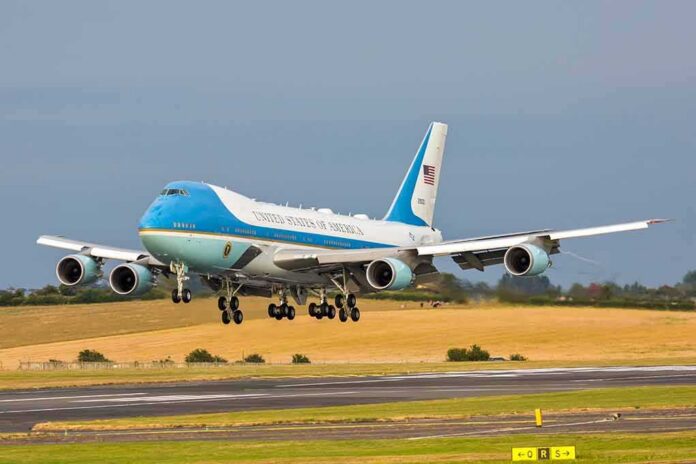
America’s next Air Force One just drove Boeing to eat another $280 million loss, and the company says it is spending more now to avoid even bigger delays later.
Story Snapshot
- Boeing booked a new $280 million loss on the VC-25B presidential jet program, pushing its total losses over $3 billion.
- The company says the charge comes from adding more production and certification resources to keep the first jet on track for 2028 delivery.
- Years of delays, supplier problems, and a tough fixed-price contract have turned this high-profile project into a long-running money drain.
- The struggle to replace Air Force One highlights how complex government programs can slip while taxpayers and workers feel the system is serving insiders, not citizens.
Boeing’s latest loss on the next Air Force One
Boeing told investors it took a $280 million charge in the second quarter of 2026 on the VC-25B program, the project that will build the next Air Force One. This new hit pushes the company’s total losses on the presidential aircraft above $3 billion, far beyond the original fixed-price contract value for two jets. Boeing said the loss is tied mainly to “additional production and certification resources” that it decided to add to the program.
Company leaders argued this extra spending is part of a plan to cut schedule risk, not a sign they are walking away from the project. Boeing President and Chief Executive Officer Kelly Ortberg called the VC-25B loss “disappointing,” but said the firm chose to “add significant resources to support the build and test schedule.” He said these new teams and tools are meant to protect the flight test program and reduce the chance of more surprises during certification.
Why Boeing says it is spending more now
Ortberg told analysts that Boeing has now lined up with the United States Air Force to move from a Federal Aviation Administration certification path to a military certification basis for VC-25B. That shift makes sense for a jet loaded with secure communications and defense features, but it also adds rules, reviews, and specialized staff. Boeing says the new charge reflects its “investment in additional production and certification resources” needed to meet those demands and keep the schedule intact.
The company still “anticipates first delivery in 2028,” even after years of delays from the original 2024 target. Boeing’s message is clear: spend more now on people, testing, and paperwork rather than face another slip that could push the first aircraft into the next decade. For a program already in what Boeing calls a “reach-forward loss,” every added dollar comes out of the company’s pocket, not the government’s. That creates pressure to fix problems once, even if it hurts quarterly earnings.
A troubled history of delays and overruns
The VC-25B program has faced trouble almost from the start. Earlier losses were tied to the COVID-19 pandemic, workforce shortages, and a dispute with the interiors supplier GDC Technics, which Boeing eventually fired. In 2021, Boeing reported a $318 million loss after coronavirus rules and supplier issues disrupted work on the presidential aircraft replacement. By 2022, losses had climbed again, with Boeing taking a $660 million hit linked to higher supplier costs, tougher technical requirements, and schedule delays.
Government watchdogs have warned that the schedule keeps slipping. A Selected Acquisition Report identified roughly a 17-month delay for both aircraft, breaching the official program baseline. Later reviews and press reports described new delivery dates pushed into 2027, then 2028, and even 2029 in one revised Boeing schedule shared with program officials. Each delay forces more rework and stretches a workforce that already faces clearance backlogs and complex wiring and environmental control system tasks.
What this says about defense contracts and the “system”
For many Americans, this story feels familiar: a giant contractor locked into a high-visibility government deal, wrestling with overruns while everyday people struggle with rising costs and a shaky economy. Boeing’s VC-25B work is under a fixed-price contract, meaning the company cannot bill taxpayers for extra costs when things go wrong. On paper, that protects the public. In practice, it has created a battle between keeping promises on schedule and absorbing losses that now exceed $3 billion.
Boeing Has Now Eaten $3B In Air Force One Cost Overruns
Boeing says it is once again paying out of pocket to ensure the first fully-equipped VC-25B jet is finally delivered in 2028, many years late.https://t.co/eVpmUBEfEM
— Tyler Rogoway (@Aviation_Intel) July 28, 2026
Conservatives see this as more proof that big government projects are bloated, slow, and shaped by political demands rather than basic value. Liberals see a powerful corporation that still holds crucial national security work, even when it misses goals and lays off workers elsewhere. Both sides can look at the next Air Force One and wonder why the “best” the system can offer is a jet that is years late, billions over internal estimates, and built inside a process that feels distant from regular citizens’ needs.
Why this matters beyond one presidential jet
This is not just about a fancy plane for President Trump or whoever follows him. The VC-25B program shows how hard it has become for the United States government and major contractors to deliver complex projects on time and on budget. Security clearances take years. Supply chains are fragile. Design changes stack up. When leaders in Washington and at big companies misjudge risk, they often try to fix it with more money and more time, not smarter planning.
As Boeing pours extra resources into VC-25B to defend the 2028 delivery date, many Americans ask a simple question: if the government and its main suppliers struggle this much on one plane, what does that say about their ability to manage bigger challenges like borders, energy, or national debt? The latest $280 million loss is one more signal that the system is strained, and that both taxpayers and workers are paying the price while elites argue over schedules and contracts.
Sources:
insidedefense.com, breakingdefense.com, techtimes.com, stripes.com, youtube.com, expressnews.com, twz.com, defenseone.com, facebook.com, bjtonline.com, janes.com, esd.whs.mil, reuters.com, ainvest.com, aviationweek.com, defensenews.com