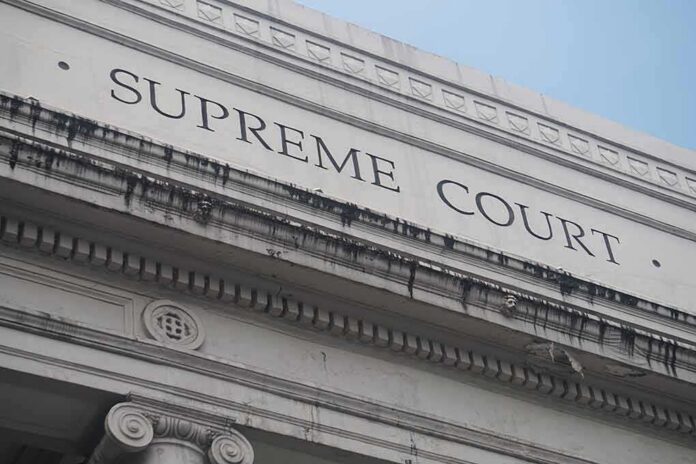
The Supreme Court will decide whether the government can hold immigrants for months without a bond hearing while deportation cases drag on.
Story Snapshot
- The Supreme Court agreed to review a Trump policy that denies many immigrants bond hearings.
- Most appeals courts rejected the policy, but others backed it, creating a circuit split.
- A recent Fourth Circuit ruling said people in removal cases must get a chance at bond.
- The outcome could reshape how long civil detainees can be held during removal proceedings.
What The Supreme Court Agreed To Decide
On Thursday in Washington, the Supreme Court took a case on whether immigrants arrested inside the country can be denied bond hearings while their removal cases are pending. News reports say the case targets a policy advanced by the Trump administration that treats many such people as subject to mandatory detention without bond hearings. The justices will hear arguments this term. Their decision could define detention rules nationwide and end years of conflicting lower court rulings.
The question turns on how to read two parts of immigration law. Section 1225 covers people seeking admission. Section 1226 covers people arrested in the interior. Several courts held that people arrested away from the border fall under Section 1226 and therefore may seek bond before an immigration judge. The Supreme Court’s 2018 ruling in Jennings v. Rodriguez rejected a fixed six-month bond rule, but left key issues open, which kept the legal fights alive.
Why Lower Courts Split On Detention Without Bond
Over the past two years, most federal appeals courts ruled against the government’s no-bond approach for many interior arrests, saying the law or due process requires access to a bond hearing. The Fourth Circuit joined that group in Lopez Garcia v. Guadian, holding that noncitizens like the petitioners must have a bond hearing and be eligible for release while their cases proceed. But the Fifth and Eighth Circuits read the statutes to permit broader mandatory detention, which produced a direct split.
This split reflects long-running tensions between border control, individual liberty, and court manageability. Supporters of the policy argue Congress used mandatory language that leaves no room for bond in many cases. Opponents respond that locking people up for months without a judge’s review violates bedrock due process and risks needless confinement of workers, parents, and long-time residents. The Supreme Court now must balance text, history, and fairness across a sprawling system.
What The Fourth Circuit’s Ruling Signals
The Fourth Circuit’s published decision affirmed relief for two detainees and emphasized that people in removal proceedings within the United States are entitled to a bond hearing under the proper statutory framework. Reporting on that decision noted sharp language criticizing mass no-bond detention and situating it outside accepted legal norms. While dramatic rhetoric drew headlines, the practical effect was clear: immigration judges in that circuit must give these detainees a chance to argue for release while their cases continue.
The Supreme Court added a major immigration dispute to its docket on Thursday, agreeing to review whether the Trump administration can impose a mandatory detention policy for long-term immigrant residents. @KelseyReichmann https://t.co/DUFv8p9slW
— Courthouse News (@CourthouseNews) October 1, 2026
Advocacy groups celebrated the ruling as part of a larger trend. Civil rights lawyers said multiple appellate courts and many district judges now reject categorical no-bond detention in these cases. They argue hearings help sort true flight risks or dangers from people who can live under supervision while waiting for a final decision. That position stresses both fairness and taxpayer cost, since detention is expensive and backlogs can stretch cases for months or even years.
What This Means For Families, Communities, And The System
If the Supreme Court upholds the government’s stance, more people arrested far from the border could face months in custody without seeing a judge for bond. That would please those who want tighter enforcement and fewer failures to appear. If the Court sides with the challengers, many detainees would gain a path to request release, easing jail crowding and costs but raising worries about compliance and public safety. Either way, Congress’s vague text and agency practice put courts in the driver’s seat again.
Americans across the spectrum see a familiar pattern here. Leaders in Washington wrote laws that leave too much gray area. Agencies then stretched those gaps in the name of control. Courts stepped in only after lives were upended and local jails filled. Many readers will see this as one more sign that the system runs for itself, not for them. The coming ruling will not fix everything, but it will set clear rules that officers, judges, and families must live with.
Sources:
oag.ca.gov, aclu.org, macarthurjustice.org, casemine.com, law360.com, justice.gov