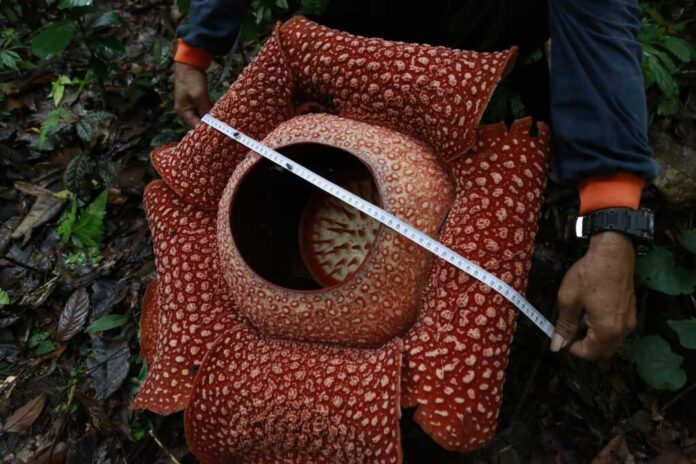
Researchers brave tiger-infested jungles to discover one of the world’s rarest flowers, Rafflesia hasseltii, after a 13-year search.
Story Highlights
- The Rafflesia hasseltii flower was discovered in the Sumatran rainforests after a 13-year search.
- The flower blooms nocturnally, an event rarely witnessed by humans.
- The research team navigated tiger-patrolled terrain to find this elusive flower.
- Dr. Chris Thorogood from Oxford led the expedition, highlighting scientific perseverance.
13-Year Quest to Find Rafflesia hasseltii
On November 19, 2025, a dedicated research team led by Dr. Chris Thorogood from the Oxford Botanic Garden achieved a monumental discovery in the Sumatran rainforests. After a challenging 13-year search, they located and documented the Rafflesia hasseltii, one of the world’s rarest flowers. The team had to traverse perilous terrain inhabited by tigers to reach the remote locations where this elusive species grows, highlighting the extreme conditions faced during their quest.
Rafflesia hasseltii, a member of the parasitic Rafflesia genus, is endemic to Southeast Asia. Known for its enormous flowers, this species depends on specific host plants, like Vitis species, for its survival. The Rafflesia’s rarity is compounded by its unpredictable flowering patterns and difficult-to-access habitats. Witnessing the flower’s nocturnal blooming was a particularly rare event, adding to the significance of the discovery.
Watch:
Conservation Challenges and Significance
The discovery underscores the urgent need for conservation efforts in the Sumatran rainforests, areas rich in biodiversity but threatened by deforestation and habitat loss. The presence of tigers in these forests indicates relatively intact ecosystems, yet they remain vulnerable to human encroachment. The sighting of Rafflesia hasseltii strengthens the case for protecting these crucial habitats, as they harbor both rare plant species and apex predators, essential for ecological balance.
Conservationists argue that the research findings provide a vital baseline for monitoring the health of these ecosystems. The data collected from observing Rafflesia’s nocturnal flowering behavior can inform strategies to preserve this rare species and its habitat. The international collaboration between British and Indonesian researchers exemplifies the global effort needed to address biodiversity loss in these threatened regions.
Team Risks Tiger Attacks, Find One Of World’s Rarest Flowers In Indonesia After 13-Year Searchhttps://t.co/rMec41kYhF
— Jennifer Harper 👍👌👍👌 (@AwakeNeverWoke1) November 26, 2025
Scientific and Public Impact
The expedition’s success demonstrates the importance of long-term research efforts in understanding and conserving global biodiversity. The emotional response captured by the research team upon discovering the flower has resonated widely, drawing public attention to the significance of protecting tropical rainforests. This discovery not only contributes to botanical knowledge but also serves as a compelling narrative for engaging the public in conservation efforts.
The story of the Rafflesia hasseltii discovery highlights the intersection of extreme environmental challenges and scientific perseverance. It serves as a reminder of the delicate balance between exploration and conservation, urging continued efforts to safeguard our planet’s most vulnerable ecosystems for future generations.
Sources:
https://www.abc.net.au/news/2025-11-26/the-13-year-search-for-a-rare-flower-in-indonesia/106047160
https://www.bbc.com/news/videos/cm28z27mm89o