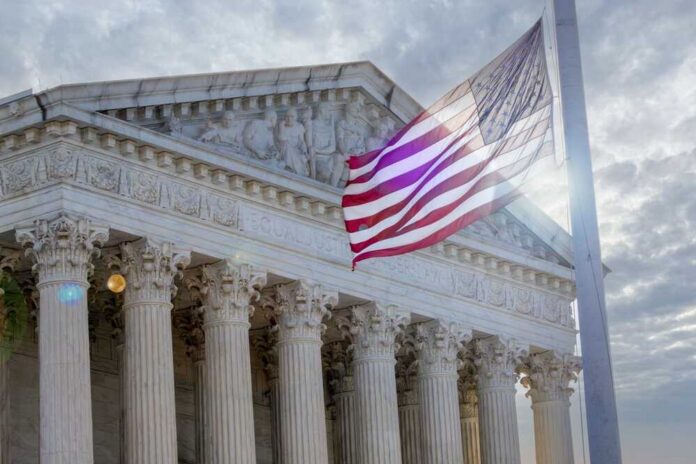
The Supreme Court’s 6-3 decision striking down Louisiana’s congressional map has ignited a firestorm over whether the federal government can legally force states to engineer voting districts based on race.
Story Snapshot
- Supreme Court ruled Louisiana’s 2024 congressional map unconstitutional racial gerrymandering despite VRA compliance intent
- Louisiana Attorney General praises decision as ending federal coercion for race-based districts
- ACLU condemns ruling as destroying key Voting Rights Act protections for minority voters
- State legislature moving rapidly to redraw maps before 2026 elections
Supreme Court Strikes Down Race-Based Redistricting
The Supreme Court ruled in Louisiana v. Callais that the state’s 2024 congressional redistricting map violated the Constitution’s Equal Protection Clause by impermissibly using race as the predominant factor in drawing district lines. The 6-3 decision, split along ideological lines with the conservative majority prevailing, mandates Louisiana redraw its six congressional districts. Federal courts had previously ordered Louisiana to create a second majority-Black district to comply with Section 2 of the Voting Rights Act, which prohibits voting practices that dilute minority representation in states where roughly 33 percent of residents are Black.
State Officials Celebrate Constitutional Victory
Louisiana’s Attorney General hailed the decision as a “seismic” win that ended the state’s “long-running nightmare” of federal court mandates forcing racially discriminatory district maps. State officials argued they were caught between contradictory federal requirements: courts demanding race-based districts under the Voting Rights Act while the Constitution prohibits such considerations. The ruling empowers the Republican-controlled state legislature to redraw maps without federal judicial oversight pressuring them to prioritize race over traditional redistricting factors like geography, community interests, and political subdivisions.
Civil Rights Groups Sound Alarm Over Voting Protections
The ACLU and allied civil rights organizations condemned the ruling as eviscerating Section 2 of the Voting Rights Act, the primary remaining tool to challenge vote dilution after the 2013 Shelby County decision gutted preclearance requirements. They argue the decision opens the door for states to draw discriminatory maps with impunity, particularly affecting Black voters and other communities of color. Critics warn this creates an impossible standard where maps drawn to remedy proven vote dilution can be struck down as racial gerrymanders, effectively neutering the VRA’s enforcement mechanisms for congressional, state, and local redistricting nationwide.
Broader Implications for Redistricting Nationwide
The decision arrives amid ongoing redistricting battles across Southern states following the 2020 census, with GOP-controlled legislatures frequently resisting additional minority-opportunity districts. Unlike the 2023 Alabama v. Milligan ruling that upheld VRA Section 2 requirements, this case narrows when race-conscious remedies are constitutionally permissible. Legal experts predict the decision will raise the bar for proving vote dilution claims while making it easier to challenge remedial maps as unconstitutional gerrymanders. The ruling potentially shifts House seat distributions toward Republicans in Louisiana and similar states, affecting congressional composition and legislative priorities.
Louisiana lawmakers are moving expeditiously to craft new maps before the 2026 election cycle, likely reverting to a single competitive Black-majority district rather than two. The decision crystallizes growing tensions between different interpretations of equal protection: whether the Constitution requires colorblind redistricting or permits race-conscious remedies for documented discrimination. For millions of Americans frustrated with federal overreach into state affairs, the ruling represents a constitutional check on judicial activism; for those concerned about minority representation, it signals an erosion of hard-won civil rights protections at a time when demographic changes are reshaping American electoral politics.
Sources:
The U.S. Supreme Court strikes another severe blow to …
Supreme Court Strikes Down Louisiana Map and Destroys Key Voting Rights Act Provision
In major Voting Rights Act case, Supreme Court strikes …