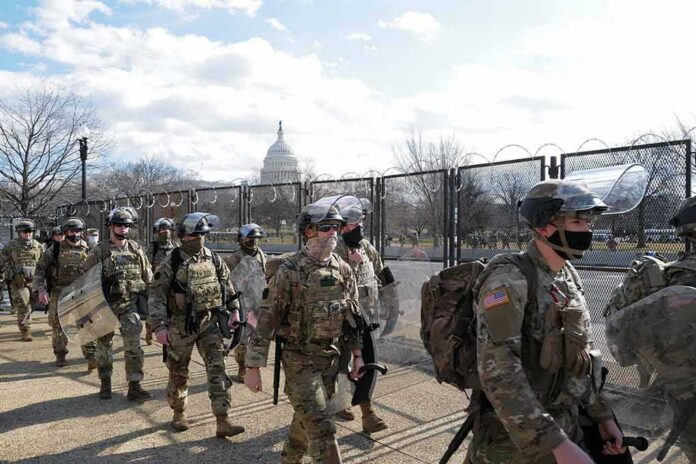
New Pentagon guidance puts more military vehicles and patrol boats on Washington, D.C. streets and waterways to back police, while courts and city leaders fight over how far that mission should go.
Story Snapshot
- Defense guidance authorizes more National Guard patrol cars, Humvees, light towers, and boats to support D.C. police operations.
- Rules say troops support law enforcement but do not make arrests or pursue suspects in military vehicles.
- A recent Barracks Row shootout wounded a Guardsman and a suspect during a deployment.
- D.C. officials object and urge states to recall troops as legal fights test deployment limits.
What the new Pentagon memo actually authorizes
The Defense Department issued written guidance on October 29 that expands National Guard support assets in the nation’s capital. The memo authorizes up to 60 marked patrol cars, military tactical vehicles such as Humvees, up to 20 light towers and generators, and District of Columbia National Guard boats. Officials said these will support federal and local police during operations aimed at gangs and drug trafficking, including near the Anacostia River where suspects could escape by water.
The guidance also sets limits on what Guard members can do. Reports say troops must wear uniforms, and the vehicles must be clearly marked “National Guard.” The policy states Guard personnel support law enforcement but do not pursue suspects or make arrests with those vehicles. For boat operations, federal officers must be on board if action or an arrest is needed. These details are meant to keep a line between military support and police powers.
A violent incident highlights the stakes on the street
During the current deployment, Guard members faced a dangerous encounter on Barracks Row. The Metropolitan Police Department said that around 11:10 p.m. on October 18, a fight broke out and a participant pulled a gun, pointed it at a Guardsman, and exchanged fire. One Guardsman and the suspect were wounded. Investigations by police internal affairs and criminal divisions were opened, and the case remains a reference point for the risks of this mission.
Supporters of the expansion point to that shootout and to river escapes as real public-safety problems. They argue added lights, marked patrol cars, tactical vehicles, and boats make police operations safer and more effective. However, available data on serious crimes are mixed. One analysis cited in coverage found robberies and theft fell after earlier Guard deployments, but homicides did not change and assaults with dangerous weapons rose slightly. That leaves open questions about impact on the worst violence.
Local leaders push back, calling for withdrawal
District leaders argue the mission is the wrong tool for everyday crime. D.C. Council Chair Phil Mendelson and several Council members have called for troops to go home. They say many out-of-state Guard members are armed but not trained in District law and lack arrest authority, which they argue does not help public safety. They want funding for locally trained Metropolitan Police Department officers instead of an open-ended Guard role.
Man Arrested After Making Gun Gesture at National Guard Soldier Near #WhiteHouse
A 28-year-old man has been arrested after allegedly pointing a finger gun at a National Guard soldier driving near the White House in Washington DC on Monday evening.
He faces charges of making… pic.twitter.com/ohJIWZJIIS
— Daily Euro Times (@dailyeurotimes) November 7, 2026
Councilmember Brooke Pinto has urged governors to recall their Guard contingents. She argues Washington is not at war and that military-style resources are not the right response for city streets. Her push has won backing from other Council members and adds pressure on states contributing troops. The disagreement shows a deeper struggle between local officials and federal decision-makers over who sets the rules for public safety in the capital.
Legal questions hang over the expanded mission
Courts have already weighed in on the broader deployment. A federal judge in 2025 found the District likely to succeed in its claim that the plan to keep thousands of Guard members in the city was unlawful and issued a temporary halt. Appeals court judges have also pressed the government on how its theory fits with the Posse Comitatus Act, which limits military involvement in domestic policing. Those challenges keep the policy on uncertain ground.
The October 29 memo adds a formal paper trail to the mission. But reporters have not published the full text, annexes, training standards, or performance metrics. Without those, the public cannot easily judge whether the assets match clear threats or how success will be measured. That gap fuels fear on both the right and left that government power grows while results stay vague. Releasing the documents and tracking outcomes could build trust across the divide.
Why it matters beyond D.C.
America often accepts National Guard help during disasters or short-term emergencies. The disputes grow when support becomes routine and looks like policing. The D.C. expansion lands in that tension. Some residents want visible action against guns and drugs. Others see armed troops and Humvees near homes and worry that heavy force replaces community policing. Clear limits, transparent goals, and honest results would help answer both crime fears and civil-liberty concerns.
Sources:
foxnews.com, thehill.com, usnews.com, politico.com, hillrag.com, military.com, abc6onyourside.com, washingtonpost.com, dc.citycast.fm