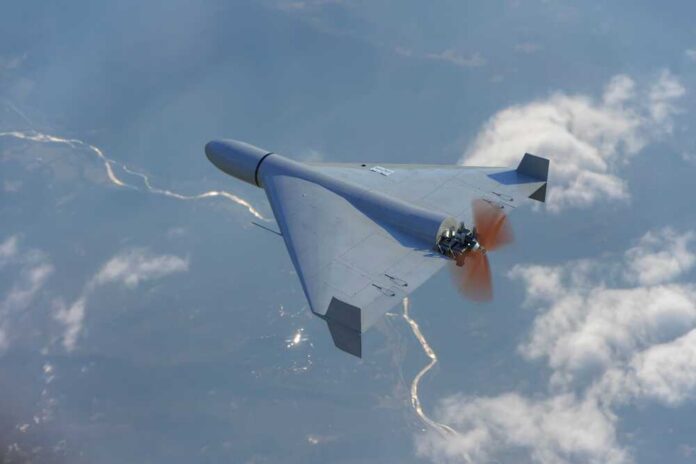
The Air Force’s choice of two new “robot wingmen” for our fighter pilots could either strengthen U.S. airpower at lower cost—or lock taxpayers into another massive, high-risk weapons program driven by contractors and artificial intelligence.
Story Snapshot
- The Air Force picked **General Atomics** and **Anduril** to build the first operational Collaborative Combat Aircraft drone wingmen.
- The service plans at least **150 drones by decade’s end**, on a path toward a fleet that could reach 1,000 or more.[2][1]
- The airframes are set, but a **separate battle over the “brain software”** is still underway among tech firms.[2][5][11]
- Conservatives must watch costs, vendor lock-in, and how far battlefield decisions shift from human pilots to algorithms.[22][24]
What The Air Force Just Bought — And Why It Matters To You
The United States Air Force has now moved from experiments to real money, awarding production contracts to General Atomics and Anduril to build the first batch of Collaborative Combat Aircraft, or drone wingmen, under Increment 1 of the program.[2] These semi-autonomous jets are meant to fly beside crewed fighters like the F-35 and future sixth-generation aircraft, carrying weapons, sensors, and even taking the first hit so U.S. pilots do not have to.[4] For families with loved ones in uniform, that promise is powerful.
Program leaders say these drones support a goal they call “affordable mass” – fielding more combat power without buying more $100 million-plus manned fighters.[4] Initial plans aim for at least 150 systems by the end of this decade, with long-term concepts still pointing to fleets of 1,000 or more platforms as industry ramps up production.[2][1] On paper, this is exactly what many conservatives want from the Pentagon: more punch for each defense dollar, not endless gold-plated projects.
How Anduril And General Atomics Beat The Legacy Giants
This path did not begin with the latest award. Back in 2024, the Air Force chose Anduril and General Atomics from a group of five companies, cutting out giants like Boeing, Lockheed Martin, and Northrop Grumman for the first prototype wave.[6][4] Those two were funded to move beyond PowerPoint decks and build “production representative” test aircraft, then prove in flight that their designs could handle real-world missions, weapons loads, and rough flight profiles.[4][5] Both firms now have named prototypes, the YFQ-42A and YFQ-44A, in testing.[7][5]
Within eighteen months of that prototype decision, General Atomics flew its YFQ-42A in August 2025, and Anduril’s YFQ-44A followed with a first flight in October 2025.[5] Flight testing with inert missiles has already started, checking how these jets carry weapons and behave under load.[5] The Air Force says this test phase feeds a larger production push and expects at least one design to move into serious numbers by around 2028, with the CCA program a “critical piece” of future air superiority.[4] For now, both companies are winners entering engineering and manufacturing development.
The Quiet Battle Over The Drone’s “Brain”
There is a twist that matters for taxpayers and for basic accountability: the Air Force is splitting the airframe from the software that flies it. Alongside the hardware awards, the service picked Anduril, Shield AI, and Collins Aerospace to keep competing to supply the autonomy software that will actually “pilot” these drones on missions.[2][5] Officials talk about a “modular open systems” approach and want different autonomy stacks to plug into the same aircraft, so the government can swap out code rather than being married to one contractor for decades.[5][14]
Some of this is already more than talk. Reporting shows Anduril’s YFQ-44A has flown a mission where it ran Shield AI’s “Hivemind” autonomy, then switched mid-flight to Anduril’s own “Lattice” software and repeated the same tasks.[11] That test suggests the Air Force is serious about keeping software interchangeable, not locked to one vendor’s secret architecture. For conservatives wary of long-term vendor dependence and runaway sustainment costs, that technical proof point is encouraging, though it will need to scale.
Promise And Risk: Cheaper Mass Or Another High-Tech Quagmire?
Supporters inside the Pentagon frame CCA as a way to change the economics of airpower: so-called “attritable” drones that are expensive enough to matter but cheap enough to lose in combat without breaking the force.[24] Market studies show military drone demand is exploding worldwide, with projections of the global drone market tripling in value between 2026 and 2031 as nations chase lower-cost, autonomous systems.[24][23] In that context, getting American industry and warfighters comfortable with high-end combat drones is seen as vital to staying ahead of China and other rivals.
The U.S. Air Force awarded production contracts to General Atomics and Anduril to build its first fleet of semi-autonomous Collaborative Combat Aircraft (CCA), moving a program that began just over two years ago from prototype to full-scale manufacturing.
USAF awarded…
— Aeronews (@AeronewsGlobal) June 18, 2026
Yet experience with other programs shows a familiar danger: glowing talk about “rapid prototyping” can hide the old pattern of big promises, shifting requirements, and spiraling sustainment bills once a system is locked in.[27] Analysts of autonomous weapons and private contractors warn that as more decisions shift to software written and maintained by companies, responsibility for mistakes can become blurred between the military and its vendors.[22] For Americans who care about clear chains of command and constitutional control of force, that is not a small concern.
What Conservatives Should Watch Next
The Trump administration’s Pentagon is pushing to move faster, but speed must not mean blank checks. Congress has already seen nearly a billion-dollar request for early CCA buys around fiscal 2027, with talk of dozens of drones in the first tranche alone.[6] Lawmakers who ran on cutting waste will need to insist on hard unit-cost caps, open technical interfaces, and competition in both hardware and software, not cozy, closed deals that grow over time. That oversight is key to avoiding another long-term budget anchor.[6][24]
There is also a basic moral and strategic line that many conservative voters care about: a human being, under lawful authority, must always remain in charge of lethal decisions. Current CCA plans describe “semi-autonomous” aircraft that team with manned fighters, not fully independent killer robots roaming the skies.[4][7] But as autonomy improves and the pressure to react faster grows, the temptation to push more judgment into algorithms will rise. Patriots who value life, clear accountability, and constitutional war powers should stay engaged as this new era of air combat unfolds.
Sources:
[1] Web – Air Force Picks General Atomics, Anduril To Build First CCA DroneS
[2] Web – Anduril, General Atomics drone wingmen clear critical design review …
[4] Web – Anduril conducts first flight test of Air Force CCA drone prototype
[5] Web – 2026 will test U.S. Air Force’s bet on drone wingmen
[6] Web – Air Force Wingman Drones: New AI Pilots, Engines, and Missiles
[7] Web – $1 Billion for Drone Wingmen: The Air Force Places Its First Order
[11] Web – Air Force Picks Anduril And General Atomics To Build And Test …
[14] Web – Shutdown to delay first flight of Anduril’s drone wingman prototype
[22] Web – Unleashing U.S. Military Drone Dominance: What the United States …
[23] Web – 5 – Drones, Automated Weapons, and Private Military Contractors
[24] Web – Military Drone Market Share & Opportunities 2026-2033
[27] Web – [PDF] Military drone systems in the EU and global context