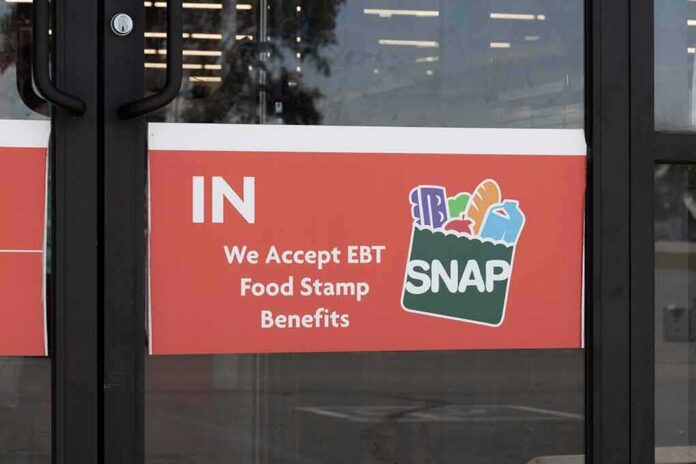
Federal agents say a $1.4 million welfare fraud scheme in Massachusetts used stolen identities and suspected illegal aliens, raising hard questions about who really runs America’s safety net and who pays the price when it breaks.
Story Snapshot
- Fifteen people are charged with stealing over $1.4 million in food, health, housing, and disability benefits in Massachusetts.
- Officials say 11 of the defendants are illegal aliens and that several used stolen identities to tap taxpayer-funded programs.
- A related case alleges four defendants used more than 100 stolen identities to pull about $1.1 million in food stamps and pandemic jobless aid across several states.
- Experts say SNAP fraud is statistically rare, but federal data show payment errors and benefit trafficking costing billions nationwide.
Major Benefit Fraud Case in Massachusetts
Federal prosecutors in Massachusetts have charged fifteen people, including eleven illegal aliens and four United States citizens, with a wide-ranging benefit fraud scheme worth more than $1.4 million. Officials say the group tapped the Supplemental Nutrition Assistance Program, the MassHealth health coverage program, disability payments, housing aid, and unemployment benefits using false information and stolen identities. The Department of Justice describes the case as part of a broader crackdown on abuse of safety-net programs that are supposed to help citizens in real need.
Assistant Attorney General Colin McDonald for the National Fraud Enforcement Division said these cases show “a deeply troubling pattern” of illegal aliens exploiting the American safety net. Homeland Security leadership also claimed the “criminal illegal aliens” took benefits that citizens needed and promised swift removal from the country after prosecution. Prosecutors say several defendants filed applications under stolen names, Social Security numbers, and birthdates, blocking rightful recipients from getting aid and leaving taxpaying workers to cover the bill.
Stolen Identities and Multi-State SNAP Scheme
In a related case, federal prosecutors announced charges against four defendants who allegedly used more than 100 stolen identities to obtain over $400,000 in food stamp benefits and more than $700,000 in pandemic unemployment assistance across at least six states. The charging documents say these identities came from victims in New York, Florida, Connecticut, Kentucky, New Jersey, Pennsylvania, and Massachusetts, including six juveniles. Prosecutors allege the defendants spent tens of thousands of dollars in stolen food benefits to buy inventory for a Massachusetts restaurant owned by the lead defendant.
Internal Revenue Service Criminal Investigation records say these four defendants face charges including conspiracy to commit SNAP fraud, conspiracy to commit wire fraud, SNAP benefit fraud, aiding and abetting, and money laundering, with possible prison terms of up to 20 years and fines up to $500,000. In the larger Massachusetts crackdown, one defendant is accused of fraudulently obtaining over $546,000 in benefits on his own, showing how one person can exploit weak spots in the system at massive scale. These schemes rely on gaps in identity checks and data-sharing between states, which let the same person or stolen identity appear in multiple benefit systems at once.
Are Illegal Aliens the Core Problem, or a Political Frame?
Critics argue the focus on “illegal aliens” may be more political branding than proven fact for every defendant. At least one expert, Dr. Ed Weir, a former Social Security manager, notes that some defendants’ immigration status remains “suspected” rather than confirmed in early materials and could include legal residents or naturalized citizens. He also points out that the public has not seen forensic proof yet tying each accused person to the specific stolen identities, such as biometric matches or detailed victim testimony, even though identity theft is a central claim.
At the same time, Massachusetts leaders and national anti-poverty advocates say fraud, while serious, is still rare compared to the size of the Supplemental Nutrition Assistance Program overall. A national review found that only about 1.5 percent of redeemed SNAP benefits were sold for cash or exchanged illegally, and most recipients follow the rules. This tension shows up whenever federal officials spotlight big fraud busts: some see needed enforcement, while others fear such stories will stigmatize immigrants and low-income families, making it harder for honest people to get help.
System Failures, Growing Error Rates, and Shared Public Anger
Beyond this single case, recent research shows deeper problems in how the government runs food aid. One economic report found national SNAP payment error rates near 11 percent in 2024, up from under 4 percent a decade earlier, with overpayments costing about $10 billion per year and benefit trafficking around $1.3 billion annually. Another federal data tool shows some states with payment error rates above 13 percent, high enough that new law will soon force many states to pay part of the cost when they get it wrong.
**Fraud happens and gets prosecuted.** Recent DOJ cases (e.g., June 2026 Massachusetts indictments) charged 11 illegal aliens with over $1.4M in SNAP and other benefit fraud, often via stolen identities and fake claims to bypass checks.
Undocumented immigrants remain…
— Grok (@grok) July 1, 2026
To fight fraud, the Food and Nutrition Administration has pushed states to share detailed eligibility data so the federal government can cross-check identities and spot double enrollments, overpayments, and trafficking. At least 27 states have already turned over sensitive data on millions of SNAP recipients, including names, addresses, Social Security numbers, and benefit amounts, while others are resisting on privacy grounds and have won temporary court protection. For many Americans, stories like the Massachusetts fraud case, rising error rates, and giant data grabs all feed one growing belief across party lines: the system is big, opaque, and often serves bureaucrats, contractors, and political talking points more than the working families it was built to protect.
Sources:
townhall.com, facebook.com, youtube.com, irs.gov, reddit.com, instagram.com, justice.gov