

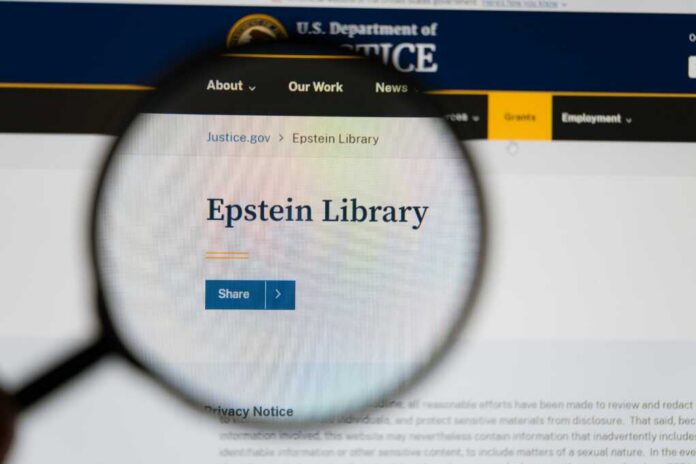
Washington are being forced—by a rare bipartisan push—to say out loud what it tried to black out in the Epstein records, and the backlash is getting personal.
Story Snapshot
- Rep. Thomas Massie says his push to unseal unredacted Epstein files has “upset a lot of billionaires,” and he now worries about his personal well-being.
- Massie and Rep. Ro Khanna co-authored the Epstein Files Transparency Act, which requires DOJ, FBI, and U.S. attorneys to release internal decision-making records.
- Lawmakers who reviewed unredacted materials say DOJ redactions appear to hide key names, including a 2019 FBI document labeling Les Wexner a co-conspirator.
- Khanna read six previously redacted names into the Congressional Record after partial DOJ compliance, escalating pressure for fuller disclosure.
Congress Demands Receipts From DOJ on Epstein Decisions
Rep. Thomas Massie (R-Ky.) says the fight is no longer abstract: after pushing to release unredacted Jeffrey Epstein files, he told a Reason podcast that he has “upset a lot of billionaires” and fears his “well being” could be at risk. Massie’s central claim is procedural and specific—Congress saw unredacted material that contradicted how the case has been publicly framed, raising questions about why certain names and references remain blocked out.
The legislative engine behind this fight is the Epstein Files Transparency Act, co-authored by Massie and Rep. Ro Khanna (D-Calif.) and passed in November 2025. The law requires the DOJ, the FBI, and U.S. attorneys to turn over internal memos, emails, notes, and other records tied to prosecutorial decisions in the Epstein matter. For voters tired of unaccountable federal agencies, this is the basic constitutional test: Congress writes the rules, agencies follow them, and the public gets transparency—especially when elite protection is the suspicion.
https://youtube.com/shorts/xk5mELhhvsk?si=NxemnZ_Anrljfh41
What Lawmakers Say They Found in the Unredacted Review
Massie and other lawmakers visited the DOJ in early February 2026 to review unredacted files, later describing a striking mismatch between what they were allowed to see and what the public had been shown. Massie said the unredacted records included disputed redactions and referenced FBI evidence of co-conspirators, including Les Wexner, the billionaire founder tied to Victoria’s Secret. Massie described a 2019 FBI document that allegedly designated Wexner as a co-conspirator in child sex trafficking, despite no prosecution.
Politico reported that Khanna took the unusual step of reading six names into the Congressional Record on February 10, 2026, after the DOJ partially complied with requests. Those names included Wexner and five others: Sultan Ahmed bin Sulayem, Salvatore Nuara, Zurab Mikeladze, Leonic Leonov, and Nicola Caputo. The reporting also noted an email connection involving bin Sulayem and correspondence referencing a “torture video,” though the available materials do not establish wrongdoing by the listed men. What is clear is the escalation: Congress is using its speech protections to bypass bureaucratic black bars.
Redactions, Victim Privacy, and the Public-Trust Problem
DOJ’s core justification for redactions has been protecting victims and sensitive information, a legitimate concern in any trafficking case. The problem, as Massie and Khanna frame it, is that the redaction pattern appears broader than victim protection and includes names of powerful adults and references to internal decision-making. When agencies redact material that lawmakers say the statute requires them to disclose, it fuels the longstanding public belief that Washington runs on two justice systems—one for connected elites and one for everyone else.
Massie’s comments also spotlight a political contradiction inside the Trump-era GOP coalition. The research notes Massie has faced attacks from President Trump and a funded primary challenge while he continues pressing for more Epstein transparency. That intraparty tension matters because oversight only works when members are willing to withstand blowback from both parties and from donors. In practical terms, the standoff is now Congress versus the executive branch’s law-enforcement machinery, with reputations—and potentially prosecutions—hanging on how much gets released and how soon.
What Happens Next: Pressure Campaign Meets a Mountain of Files
Khanna argued that if lawmakers found six names in roughly two hours of review, the full universe of material could be massive—he referenced “3 million files” as the scale of what remains. That number underscores a reality check: the public still does not know what is in the unreleased tranche, and neither source claims a complete picture yet. But the act of forcing partial redactions and placing names into the Congressional Record is a clear strategy to keep the DOJ from slow-walking disclosures behind process and paperwork.
Massie also leveled serious criticism at Attorney General Pam Bondi, accusing her of “criminal negligence” in how the matter has been handled, while the reporting includes responses emphasizing victim-protection concerns and, in Wexner’s case, a representative stating he cooperated fully and was never a target. With limited public access to the underlying documents described by lawmakers, the strongest verified takeaway is structural: Congress has begun prying open a case that spans multiple administrations, and every remaining redaction now carries a bigger burden of explanation.
Sources:
‘I’ve Upset a Lot of Billionaires’: Thomas Massie Epstein Conspiracy Is Bigger Than Watergate
Ro Khanna names names