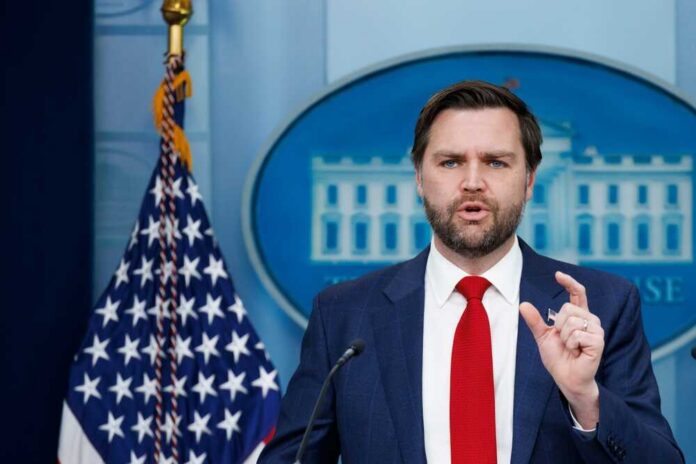
When the sitting vice president goes on the biggest podcast in the world and calls aliens “demons” while blaming war hawks and a close ally for wrecking a peace deal, it tells us as much about Washington’s chaos as it does about his beliefs.
Story Snapshot
- Vice President JD Vance told Joe Rogan he believes so‑called aliens are actually “demons,” reflecting his Christian worldview.
- Vance claimed hawkish officials inside the Trump administration sabotaged a planned Iran peace Memorandum of Understanding (MOU).
- He suggested Israel meddles in United States policy debates around Iran and Middle East strategy.
- The long, unfiltered podcast appearance highlights how major politicians now use podcasts to push edgy or unproven ideas without normal media checks.
Vance’s demon talk and why it matters
During his marathon appearance on “The Joe Rogan Experience,” Vice President JD Vance repeated a view he has shared before: that what people call aliens or unidentified flying objects may in fact be “demons.” He has made similar comments on conservative podcasts, saying, “I don’t think they’re aliens. I think they’re demons anyway,” and tying that belief to his Christian faith and interest in UFO files. For Americans already worried that leaders are out of touch, hearing a top official frame national security mysteries in spiritual warfare terms raises fresh questions about how decisions are made at the very top.
Vance has said he has not yet read the classified government files on unidentified aerial phenomena that President Trump ordered released, but he has still floated theories in public interviews. Supporters may hear this as refreshing honesty about faith and the unseen world. Critics see an official with top‑secret access speculating in public before checking the evidence. For citizens on both the right and the left who feel the “deep state” hides the truth, the mix of religion, secrecy, and wild claims only deepens mistrust toward a government they already believe is not leveling with them.
Claims of sabotaged Iran peace and hawks inside the White House
In the same Rogan interview, Vance turned from demons to diplomacy. He described internal fights over a proposed Memorandum of Understanding with Iran, suggesting that hard‑line national security advisers worked to sink or weaken a peace framework. Reporting on the episode notes that Vance “cautiously defended” the ongoing war with Iran while also saying the White House had mishandled other sensitive issues, such as the release of files related to Jeffrey Epstein. That mix of loyalty and criticism paints a picture of an administration split between public unity and private warfare.
For many conservatives, the idea that “hawks” inside the national security world sabotage peace efforts fits years of anger at endless wars and a military‑industrial complex that seems to profit no matter who wins elections. Many liberals, meanwhile, hear Vance confirming what they already suspect: that quiet insiders, not voters, steer war and peace. When a sitting vice president says on a podcast that unnamed officials undercut a peace MOU, it reinforces a shared fear across the political spectrum that shadowy players, not the public, set America’s course overseas.
Israel’s role and fears of foreign meddling
Vance also suggested that the government of Israel pushes hard inside Washington debates, especially around Iran policy and any move toward a peace understanding. His remarks echoed a long‑running tension in United States politics: how to support a key ally without letting its preferences override American interests. Both conservative and liberal critics have warned for years about foreign governments using lobbyists, think tanks, and back‑channel pressure to shape United States policy in ways regular citizens never voted for.
When a vice president talks this way on a huge podcast, it gives those worries new fuel. Some on the right will see his comments as proof that “globalist” networks and foreign allies interfere with America First goals. Some on the left will hear confirmation that powerful partners and wealthy donors pull strings behind the scenes. Either way, the common thread is a sense that ordinary Americans—who send their kids to war and pay the bills—are still the last ones told what is really going on with allies, enemies, and secret deals.
Podcasts, unfiltered talk, and the crisis of trust
Vance’s Rogan interview is also part of a bigger media shift. Studies by the Brookings Institution found that nearly 70 percent of major political podcasters have shared at least one unsubstantiated or false claim, and about one in every twenty episodes contains such content. Researchers also found that the top shows spreading misleading claims are mostly right‑leaning, but the deeper problem goes beyond one side: people now treat long, casual podcasts as trusted news sources, even though there is little fact‑checking or oversight.
JD Vance to Joe Rogan: Aliens Are Demons, Hawks Sabotaged the MOU, Israel Is Meddlinghttps://t.co/3tg3lCJNfs
— PJ Media (@PJMedia_com) July 16, 2026
For frustrated Americans, this new media world cuts both ways. On one hand, podcasts let politicians like Vance dodge scripted talking points, blast the “deep state,” and admit that the system is broken. On the other hand, wild claims about demons, secret saboteurs, and foreign meddling can blur the line between real corruption and rumor. In a country where many already believe the federal government serves elites instead of citizens, unfiltered shows can either shine light on hidden problems—or deepen the fog that keeps people divided and in the dark.
Sources:
pjmedia.com, youtube.com, theguardian.com, tandfonline.com