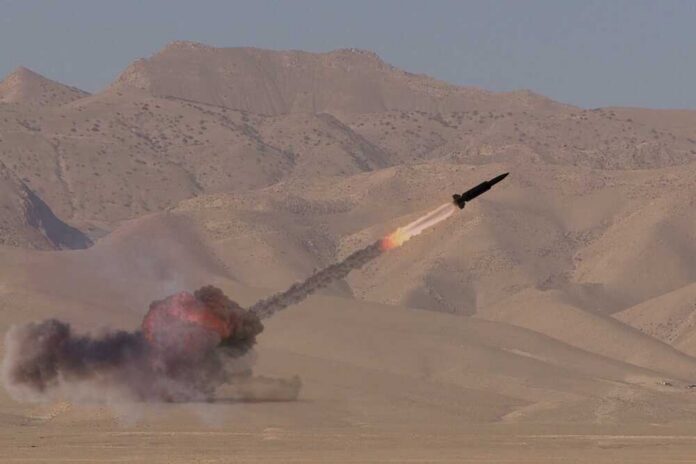
Iran’s first reported combat use of its solid-fuel Sejjil ballistic missile is a reminder that sanctions and diplomacy don’t automatically stop hostile regimes from building faster, harder-to-detect strike options.
Quick Take
- Iran reportedly launched the Sejjil missile for the first time in the conflict during what it called its 54th wave of attacks.
- Sejjil’s solid-fuel design can shorten warning time, complicating missile defense decisions for Israel and U.S. forces in the region.
- U.S. and Israeli strikes have degraded Iran’s launcher infrastructure, but analysts still estimate “several dozen” launchers remain in hardened facilities.
- Israel has warned the U.S. that it is running critically low on ballistic-missile interceptors as sustained attacks strain defenses.
Sejjil’s debut signals a faster-launch threat across the region
Iran’s latest escalation centers on the Sejjil, a two-stage, solid-fuel, medium-range ballistic missile that multiple reports describe as capable of reaching roughly 2,000 to 2,500 kilometers with up to a 1,000-kilogram payload. That range puts Israel, Saudi Arabia, Turkey, and several U.S. installations within potential reach. The “doomsday weapon” label is journalistic framing, but the underlying point is serious: solid fuel can enable quicker launches and less warning time.
Iran reportedly introduced the Sejjil in what it called the 54th wave of attacks, which would mark a qualitative change from older liquid-fuel systems that typically require more visible preparation. Reports also describe Sejjil variants or payload options that can include cluster munitions—sometimes cited as roughly two dozen submunitions, with other claims of higher counts. Even without perfect public clarity on configurations, the operational implication remains: air defenses must cope not only with incoming missiles but potentially with complex dispersal patterns.
Airstrikes have damaged launch capacity, but hardened basing keeps risk alive
U.S. and Israeli strikes have reportedly damaged Iran’s missile launch infrastructure, including mobile launchers and silos, and analysts say launch rates have dropped sharply compared with earlier phases of the fighting. That degradation matters, because it suggests Iran cannot sustain unlimited volleys at the same tempo. At the same time, estimates that “several dozen” launchers remain operational inside hardened facilities underline a persistent challenge: survivable basing makes a total rollback difficult without a wider campaign.
For American audiences—especially those skeptical of “paper deterrence”—the lesson is straightforward. When a regime plans for redundancy and underground protection, there is no single “silver bullet” strike that ends the threat overnight. A limited-government conservative instinct to demand measurable outcomes applies here: if U.S. policy aims to reduce risk to troops and allies, the key metrics become launcher attrition, production disruption, and interception sustainability, not rhetorical milestones or vague assurances.
Israel’s interceptor shortage highlights a strategic math problem
Israel has reportedly told U.S. officials it is running critically low on ballistic missile interceptors as Iran’s sustained attacks strain air defenses. Even when interception rates are high, defensive inventories are finite, and replenishment is not instantaneous. Iran’s apparent use of persistent waves compounds this pressure by forcing defenders to choose between protecting population centers, military sites, and critical infrastructure. In practical terms, the side that can manufacture and field usable munitions faster often gains leverage over time.
The cluster-munitions element matters in that inventory math because defenses may need more intercept attempts per incoming missile depending on how the threat is assessed. When warning time is reduced—one of the stated concerns with solid-fuel systems—commanders face tighter decision windows, raising the risk of costly over-engagement or, alternatively, under-engagement. Those are not ideological talking points; they are the hard mechanics of missile defense under stress, and they shape the political choices leaders make in Washington and Jerusalem.
What this means for U.S. policy: deterrence, transparency, and war-weariness
The broader strategic takeaway is that Iran’s missile program, built over decades under sanctions and isolation, has not been eliminated by pressure alone. Some analysis frames Iran’s buildup as a response to threats after 1979, and the current phase shows how that long investment can surface at a decisive moment. Reports also reference a claimed shift toward “militarized nuclear weapons,” but public details remain limited, and readers should treat that as an area requiring verification and clearer sourcing.
For a U.S. public that increasingly believes the federal government serves insiders first, overseas crises often feel like another open-ended commitment sold with shifting rationales. In this case, the concrete issues are visible: protecting U.S. forces, keeping sea lanes stable, and supporting an ally facing interceptor depletion—while avoiding mission creep. Congress and the administration owe citizens transparency on objectives, timelines, and costs, because “trust us” is no longer sufficient in an era defined by war fatigue and institutional skepticism.
Sources:
What Is Minuteman-III Missile, the ‘Doomsday Weapon’ US Tested Amid War With Iran
Upheaval in Iran Doesn’t Work Out Well