
An unprecedented public feud between President Trump and the first American-born pope is shattering centuries of diplomatic protocol, exposing a deepening rift over war and governance that neither leader will concede.
Story Snapshot
- Pope Leo XIV publicly condemned U.S. and Israeli military actions in Iran, calling war a “delusion of omnipotence”
- Trump fired back on Truth Social, labeling Leo “weak on crime” and claiming the pope owes his position to Trump’s influence
- Leo responded defiantly aboard a papal flight: “I have no fear” of Trump, vowing to continue advocating for peace
- U.S. Catholic bishops condemned Trump’s attacks as “disrespectful” to the Vicar of Christ
- The clash marks the most visceral and public pope-president confrontation in modern history
A Battle Between Two American Leaders
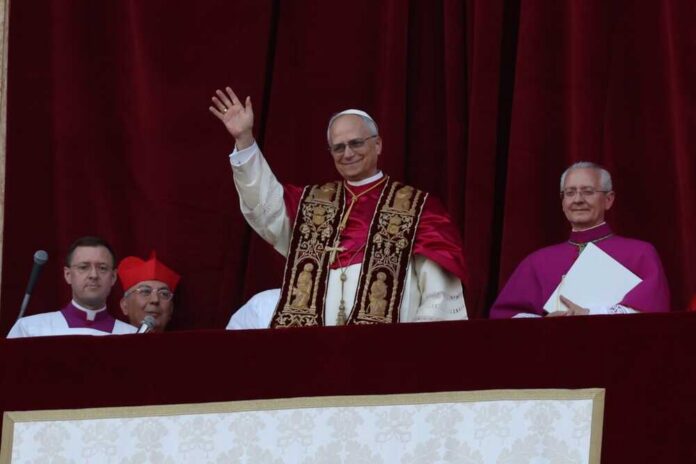
Pope Leo XIV delivered a sermon at St. Peter’s Basilica on April 11, 2026, criticizing ongoing conflicts in Iran and elsewhere as driven by “idolatry of self” and a “delusion of omnipotence.” The first American-born pope, Leo has grown increasingly vocal about opposing wars that he views as contrary to gospel teachings. By Sunday night, President Trump responded on Truth Social with a blistering attack, calling Leo “weak on crime,” “terrible for foreign policy,” and suggesting he’s not a legitimate pope. Trump even implied that Leo’s election was politically motivated by Trump’s own presidency, a claim that struck many observers as absurd given the Vatican’s independence.
Trump doubled down on Monday, calling Leo “very liberal” and opposed to law and order. He briefly posted—then deleted—an AI-generated image depicting himself in a Christ-like pose, which Catholic leaders condemned as blasphemous. Meanwhile, Leo was en route to Algeria for a peace mission. Aboard the papal flight, he told journalists he has “no fear” of Trump and will continue speaking out against wars where “too many innocent people” are being killed. He emphasized his focus is the gospel, not politics, but made clear someone must stand up for the suffering.
Breaking Vatican Norms of Discretion
The confrontation shatters long-standing Vatican protocol. Historically, popes avoided naming political leaders in public criticism, preferring quiet diplomacy even during heated disputes. Pope Francis clashed with Trump in 2016 over immigration policy, calling border walls “un-Christian,” but that spat was resolved behind closed doors. This time, both men are American, making the clash intensely personal and unprecedented. Vatican correspondent Colleen Dulle noted that Leo’s willingness to respond mid-flight, before even reaching his destination, signals a dramatic shift. The shared nationality transforms this from a diplomatic disagreement into what Fort Worth Bishop Michael Olson described as a “visceral and public” battle unlike anything in history.
Trump’s refusal to apologize, insisting Leo is “wrong,” keeps the feud alive. His use of social media to launch ad hominem attacks against the pope—questioning his legitimacy, his politics, and even his faith—represents a departure from how presidents have traditionally engaged religious authority. For many Americans, especially those frustrated with elites who seem more interested in power than principle, this spectacle raises uncomfortable questions. Is this a president defending necessary national security policies, or a leader unable to tolerate criticism? Is this a pope courageously speaking truth to power, or overstepping into political territory? The answers depend on one’s perspective, but the breakdown in decorum is undeniable.
Catholic Leaders and Voter Backlash
The U.S. Conference of Catholic Bishops swiftly condemned Trump’s statements as “disheartening” and “disrespectful.” Archbishop Paul Coakley called Pope Leo the “Vicar of Christ,” not a politician, and emphasized that attacking him undermines the Church’s moral authority. The White House Religious Liberty Commission also deemed Trump’s remarks “inappropriate,” demanding an apology. These rebukes from within conservative religious circles reveal how the feud is fracturing Trump’s support among a key constituency. Many Catholic voters backed Trump for his stances on religious liberty, abortion, and traditional values, but attacking the pope crosses a line for some.
The political implications are significant. U.S. Catholics represent a diverse voting bloc, and this clash risks alienating those who prioritize Church teaching over partisan loyalty. Long-term, the precedent of a president openly feuding with a pope—especially an American one—could reshape how religious authority intersects with political power. For voters tired of watching elites squabble while ordinary Americans struggle with economic hardship, inflation, and endless foreign entanglements, this spectacle reinforces a sense that leaders on all sides are more concerned with ego and control than addressing real problems. Whether it’s Trump’s refusal to back down or Leo’s departure from Vatican restraint, both appear willing to escalate rather than seek common ground. That should concern anyone who believes institutions—whether government or Church—exist to serve the people, not the ambitions of those who lead them.
Sources:
Pope says ‘enough of war’ and decries ‘delusion …
Pope Leo XIV denounces the ‘delusion of omnipotence’ he …
President Trump is openly condemning Pope Leo XIV after …
Following Trump’s critical post, Pope Leo continues his plea for peace