A viral claim that a Portland anti-ICE protester “accidentally set himself on fire” is racing around the internet—even though the most solid public records point to a different, more sober reality.
Quick Take
- No verified reporting in the provided research confirms a Portland protester accidentally lighting himself on fire; the closest documented episode involves protesters igniting materials against an ICE facility wall.
- Portland Police say the June 11, 2025 incident involved reckless burning and an assault on an officer, with arrests tied to alleged crimes—not speech.
- Multiple reports describe the protests as relatively small and geographically confined, contradicting “city-wide inferno” narratives.
- Ongoing clashes have shifted into courts, including a January 2026 dispute involving protest footage and police records.
What Actually Happened at the ICE Facility on June 11, 2025
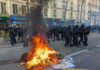
Portland’s most concrete, on-the-record account of the June 11, 2025 fire incident comes from law enforcement reporting: investigators described a man stacking flammable material against the ICE facility in South Portland, followed by another individual placing a lit flare onto that material, igniting a fire. Federal personnel reportedly extinguished the flames before major damage. Police later arrested two suspects tied to the burning and a third suspect accused of assaulting an officer during the arrests.
The official narrative matters because it draws a line between constitutionally protected protest and criminal conduct. Police statements emphasized that arrests were made for alleged offenses such as reckless burning, trespass-related behavior, and an alleged assault—not for political viewpoints. That distinction is central for Americans who support lawful dissent but reject arson, attacks on officers, or blocking facility access as “activism,” especially when public safety is at risk.
The “Accidentally Set Himself on Fire” Claim Doesn’t Match Verified Accounts
The user’s research summary is blunt: no verified video or credible reporting was found that matches the specific premise of a protester accidentally setting himself on fire. The nearest corroborated incident involved deliberate ignition of materials placed against the building, not self-immolation. That gap between viral framing and documented facts is a familiar pattern in today’s political media environment, where short clips and sensational captions often outrun confirmation.
That doesn’t mean there was no fire or no danger—there clearly was. Reports describe small, quickly suppressed fires and repeated nighttime demonstrations near the facility. But the difference between “a protester caught himself on fire” and “a protester ignited materials near a federal building” is not a nitpick; it changes the moral and legal meaning of the event. Accuracy is also essential for public trust when tensions are already high.
Scale and Reality: Smaller Crowds, Confined Area, Big National Narratives
Several sources in the research characterize the Portland anti-ICE protests as limited in size and largely confined to a small area, often described as a two-block radius. Some nights reportedly drew fewer than 100 participants and sometimes fewer than two dozen. Fire response data cited in the research also suggests relatively few dispatches for fires in that period, often involving minor incidents or even misreported events.
Political messaging often turns Portland into a symbol—either of federal “crackdowns” or of citywide disorder. But the research points to a more narrow, localized picture: recurring gatherings near one facility, punctuated by specific criminal allegations like reckless burning and assaults. For conservative readers concerned about law and order, that distinction is important: it suggests a targeted public-safety challenge rather than an uncontrollable metropolis, and it underscores why enforcement should focus on crimes without trampling lawful speech.
Federal Response, Local Politics, and the 2026 Legal Fight Over Records
The research also describes ongoing friction between federal actions at the site and local political reactions. Reports reference federal agents using crowd-control munitions, while local police sometimes facilitated medical aid. Local leaders and unions publicly criticized federal tactics, while federal officials highlighted arrests and alleged offenses tied to violence or property damage. Those competing narratives have fueled distrust on all sides and kept the issue alive well beyond June 2025.
By January 2026, the conflict had moved into the courts, with a reported dispute involving the Department of Justice and Portland attorneys over police records tied to ICE protest footage. For Americans who watched institutions get politicized during the Biden era, this kind of records fight raises a basic question: will government transparency apply evenly, or will ideology dictate which facts the public is allowed to see? The available reporting doesn’t resolve every detail, but it confirms the fight is ongoing.
Sources:
Protesters Place Flammable Material, Lit Flare Against ICE Building; Officers Arrest Three
Donald Trump / Portland ICE arrest burning ground (PolitiFact fact-check page)
Portland police arrest four during ICE protest following deadly Minneapolis shooting
Portland mayor says to Donald Trump those who continue to work for ICE resign
A timeline of police activity at Portland ICE facility since protests began in June
Portland Oregon ICE protest Trump footage court