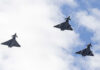
Israeli warplanes just turned Beirut’s skies into a loud, low-altitude warning—then scattered QR-coded propaganda that Lebanese officials say could expose civilians to recruitment and hacking.
Story Snapshot
- Israeli aircraft flew low over western Beirut on March 13, 2026, triggering panic with multiple sonic booms before leaflets rained down.
- The leaflets urged Lebanese civilians to “disarm Hezbollah,” framing the group as “Iran’s shield,” and pointed people to QR codes and online contacts.
- Lebanon’s military warned residents not to scan the QR codes, citing legal and security risks, including potential phone compromise and data access.
- Reports described the operation as the first leaflet drop over Beirut in two years, signaling an expanded psychological-warfare push into the capital.
Low-Altitude Overflights Rattle Western Beirut Neighborhoods
Israeli warplanes flew at low altitude over western Beirut on March 13, 2026, producing a series of loud booms that sent residents into immediate alarm. On-the-ground reporting described four successive blasts at short intervals, followed by clouds of paper leaflets drifting down. The leaflets appeared over populated districts including Verdun, Hamra, and Ain al-Mreisseh, an approach that maximized visibility and fear even before the message was read.
The distribution method matters as much as the text. Low flights that create sonic booms are inherently intimidating, and in a dense capital city they can be indistinguishable from the opening moments of a strike. Multiple outlets treated the incident as a significant development because it combined kinetic pressure—noise, proximity, and implied capability—with messaging aimed directly at civilians. That blend is consistent with psychological operations designed to shape behavior without a ground presence.
Leaflets Target Hezbollah Support and Push Direct Civilian Contact
The leaflets urged Lebanese citizens to take action against Hezbollah, explicitly calling on people to “disarm Hezbollah” and describing it as “Iran’s shield.” That framing is built to isolate Hezbollah from the broader public by tying the organization to Iranian interests rather than Lebanese sovereignty. Several reports emphasized an unusual element: QR codes and contact pathways that linked to WhatsApp channels and a Facebook page associated with Unit 504, an Israeli military intelligence unit.
That technical detail shifts the episode from broad propaganda into a more targeted intelligence play. A leaflet drop that simply broadcasts a slogan is one thing; a leaflet that tries to move civilians into a traceable digital conversation is another. The reports described the Unit 504 linkage as an attempt to facilitate direct communication, potentially to solicit tips or recruit sources. In practical terms, the operation invited ordinary residents to engage in a high-risk information channel during an active conflict.
Lebanon’s Military Warns QR Codes Carry Legal and Security Risks
Lebanon’s military responded with an unusually explicit warning: citizens should not scan the QR codes because of “legal and security risks,” including the possibility of hacking phones and accessing personal data. The warning also stated the codes led to Unit 504, described as responsible for recruiting agents. In a region where smartphones hold personal contacts, location history, and financial data, even the perception of compromise can chill public life.
From a common-sense standpoint, the Lebanese warning highlights how modern conflict now extends into the digital devices people carry in their pockets. QR codes are easy to scan, but they are also an effortless way to funnel a user into a controlled link, collect identifiers, or begin a conversation that can be exploited. Even if some scans were merely curiosity, the government’s message was clear: treat the leaflets as an operational trap, not harmless paper.
Ceasefire Appeals Collide With Escalation and Unclear Casualty Context
The leaflet incident unfolded as UN Secretary General Antonio Guterres visited Beirut and called for a ceasefire, urging both Israel and Hezbollah to stop the war and arguing that Lebanese people were “dragged into” the conflict. The timing underscored the gap between diplomatic messaging and battlefield signaling. Reports also pointed to continuing strikes, including damage to infrastructure such as a bridge over the Litani River and attacks affecting Beirut.
Israeli warplanes drop leaflets over Beirut, causing panic https://t.co/mH9oC5iSJ4
— Naharnet (@Naharnet) March 13, 2026
Casualty reporting in the available coverage showed the limits of clarity during fast-moving conflict. One account referenced more than 25 deaths in Beirut while also citing at least 687 people killed in Israeli attacks on Lebanon over the preceding two weeks, including 98 children according to Lebanese authorities. The sources did not fully reconcile whether the Beirut figure was a subset of the broader total or a separate tally, leaving some ambiguity. What is clear is that the leaflet drop arrived amid sustained violence, with civilians absorbing both physical danger and psychological pressure.
Sources:
Israeli warplanes drop leaflets over Beirut, causing panic
Israeli warplanes drop leaflets over Beirut, causing panic
IDF leaflets Lebanon disarm Hezbollah
Lebanese media: IDF dropped leaflets over Beirut telling civilians to act against Hezbollah
Israeli drone strikes target Nabaa north of Beirut and Jnah in the south (live)