As Gaza marked nearly a year since a fragile truce, a pre-dawn Israeli strike killed five people in a Gaza City apartment, including a Christian mother and her daughter, exposing again how civilians are still paying the price of a stalemated war.
Story Snapshot
- Health and civil defense officials said five people died; four were women.
- Reuters video captured a neighbor describing pulling the Christian mother and daughter from rubble.
- A funeral for the two Christian women was held at St. Porphyrius Orthodox Church.
- The Israeli military offered no immediate comment on the strike.
What Local Officials And Witnesses Reported
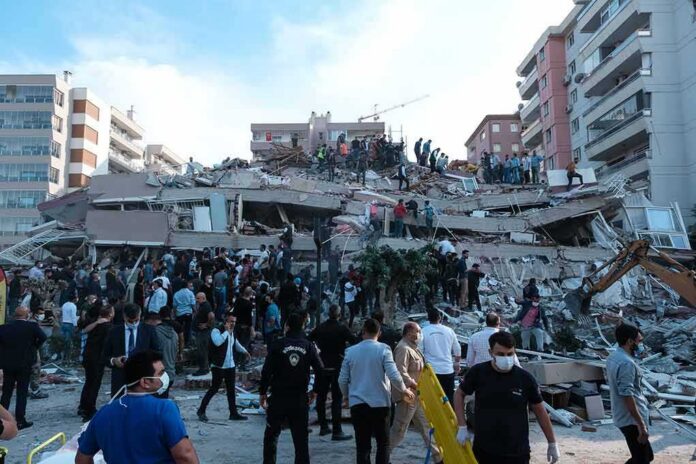
Health and civil defense officials in Gaza said an Israeli airstrike hit an apartment building in Gaza City early Saturday, killing at least five people. Four of the dead were women. Among those killed were a Christian mother, identified as Maisa Abu Dawoud, and her daughter Mary, according to medics and church sources cited by Reuters. A Reuters video showed a neighbor decrying the deaths and describing pulling bodies from the rubble after the blast. Reuters said the Israeli military did not immediately comment.
Video from the scene underscores a grim pattern in this war: neighbors rush in first, then hospitals, civil defense, and churches confirm names and numbers. This on-the-ground chain often forms the first public record. In dense urban combat, early counts of the dead are usually more certain than answers about who or what was targeted and why. Independent teams struggle to reach sites, so the first facts often come from local institutions and wire services.
Gaza’s Christians And A Wider Civilian Toll
The funeral for the mother and daughter at St. Porphyrius Orthodox Church highlights the strain on Gaza’s tiny Christian community, which has seen multiple deaths during the conflict. A church funeral video circulated as mourners named the women and prayed over their bodies. Past reporting has documented other deadly incidents at church compounds during the war, which drew condemnation from religious leaders and raised broader concerns over civilian protection in sacred or sheltering sites. These events deepen fear among minorities already living under siege.
Counting civilian deaths in Gaza remains hard. Reporters face limits on access. Hospitals are overloaded. Many bodies remain under rubble. Analysts note that initial death reports, often from health officials, are broadly useful for totals, but they rarely settle questions about combatant status or intent. That is why legal judgments take longer and often remain disputed. Several studies and news analyses explain why early numbers can be credible yet incomplete in detail.
Why This Strike Resonates Across The Political Divide
Americans across the spectrum see a familiar breakdown here. A strike levels a home. Civilians die. Officials offer few details. Accountability drifts. People feel that powerful actors, foreign and domestic, act without clear checks. This feeling has grown as wars stretch on and basic answers lag. Clear, prompt explanations from the governments involved could ease doubt. In this case, reporters noted there was no immediate comment from the Israeli military, leaving families and neighbors to fill the silence.
For conservatives who prize order and clear rules of engagement, unexplained strikes read as failure to define aims and limit harm. For liberals who stress human rights, the deaths of women and a religious minority speak to a wider crisis of civilian safety. Both groups see a system that answers late, if at all. The shared worry is not abstract. It is tied to names, bodies, and a church funeral on a crowded street in Gaza City.
Legal And Strategic Questions That Remain Open
Officials have not released a target description, strike rationale, or after-action review for this incident. Without that, outside observers cannot assess proportionality or adherence to the laws of war. This gap is common in fast-moving conflicts, but it leaves families without closure and invites further anger. The lack of immediate military comment here mirrors many past cases that only received partial answers weeks or months later, if at all.
Strategically, urban air campaigns in dense areas like Gaza City often trade near-term military aims for long-term civilian harm and global backlash. Repeated civilian deaths, especially in apartments and religious compounds, harden views and reduce space for diplomacy. The funeral at St. Porphyrius and the neighbor’s testimony will shape memory far beyond the blast site. Those images can outlast brief statements and shape how both sides, and the world, judge the conduct of this war.
Sources:
youtube.com, aa.com.tr, reuters.com, ground.news, en.royanews.tv