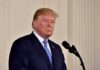
President Trump publicly said in Dublin that he would “love to see” Ireland become one unified country, calling reunification a “fantastic thing.”
Story Snapshot
- Trump voiced personal support for Irish reunification during a Dublin appearance after meeting the Irish prime minister.
- He noted the United Kingdom “will have something to say,” acknowledging the constitutional process.
- United Kingdom officials said their position on unity remains unchanged following the remarks.
- The Good Friday Agreement requires majority support in both jurisdictions for any change.
What Trump Said And Where He Said It
President Trump told reporters in Dublin on September 12 that he would “love to see it unified,” describing a united Ireland as a “fantastic thing.” He made the comments after meeting Irish Prime Minister Micheál Martin. Multiple outlets reported the same core phrasing on the same day, which anchors what was said and when. Some coverage also quoted Trump saying the United Kingdom would have “something to say” on the matter, signaling awareness of legal and political steps.
Later the same day, Trump echoed the sentiment in a separate setting, using casual language and a light tone. Broadcast segments captured him joking about “loving mergers,” while keeping the idea that reunification would be “very cool” in play. Those clips reinforced that the message was not a one-off line, even if the style felt off the cuff to many listeners. A brief caveat is that outlets differ slightly on exact wording across clips and quotes.
How The United Kingdom And Ireland Factor In
Downing Street signaled no shift in policy following Trump’s remarks, stating the United Kingdom’s position on Irish unity remains unchanged. That response aimed to reduce any sense of sudden pressure on the constitutional question. Officials pointed to the existing framework that governs potential change. The United Kingdom’s stance is shaped by domestic consent rules and current public opinion, which do not show a clear majority for a unity vote in Northern Ireland at this time.
The constitutional path is set by the Good Friday Agreement. Any move toward a united Ireland requires majority consent in both Northern Ireland and the Republic of Ireland. That consent must be “freely and concurrently given,” which means a simple statement of support from a United States president cannot by itself trigger change. The agreement leaves the timing of any referendum to the judgment of the United Kingdom government based on evidence of likely support.
Why This Matters For Voters And Diplomacy
Trump’s words matter because they came from a sitting United States president on Irish soil. That gives them symbolic weight, even if they do not alter the rules. The comments also tap into decades of American interest in Northern Ireland, from President Carter’s statements to President Clinton’s role in the peace process. Supportive talk can shape tone, signal priorities, and affect how leaders and parties frame next steps on cross‑border relations.
IRELAND–UNITED KINGDOM–UNITED STATES — Dublin, 12 September 2026; remarks reported at approximately 10:20 UTC
President Donald Trump has publicly said he would “love” to see the Republic of Ireland and British-administered Northern Ireland reunified.
Speaking after meeting… pic.twitter.com/TS5tvpdn3Y
— GSR | Global Scenes Reports (@GSRReports) September 12, 2026
For Americans, the episode highlights a larger concern: big choices often get made in brief moments, while complex systems change slowly. People across the political spectrum feel elites manage headlines while avoiding hard problems. This case shows how one line can stir reaction, yet the process still depends on public consent and patient work. That is the core guardrail of the Good Friday Agreement, and it will guide any future debate on Irish unity regardless of who speaks next.
Sources:
whio.com, nampa.org, globalbankingandfinance.com, youtube.com, trumpwhitehouse.archives.gov