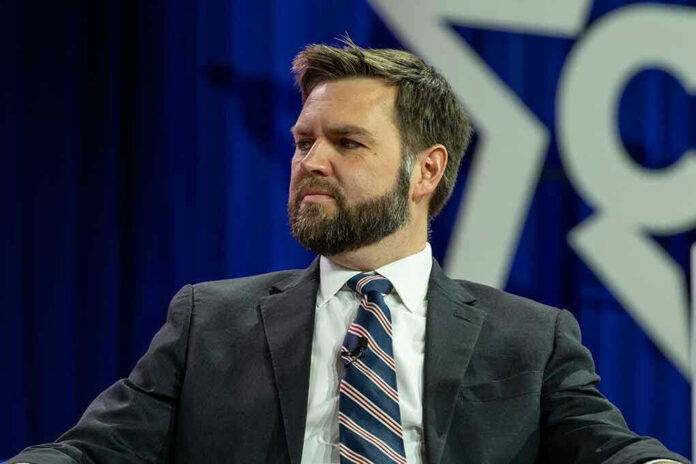
Vice President JD Vance walked into a skeptical room in Las Vegas — and still left with access, applause, and new questions about where the GOP is heading on Israel and antisemitism.
Story Snapshot
- Vance spoke behind closed doors to the Republican Jewish Coalition, signaling continued access despite tensions.
- RJC publicly welcomed Vance as a “friend,” even as several Jewish conservatives have criticized his stance on Israel.
- Named Republican Jewish voices said donors remain wary but see the meeting as a step toward trust.
- The sit-down highlights a bigger GOP test: balancing pro-Israel donors and a populist base suspicious of foreign influence.
Closed-Door Stage Shows Access, Not Agreement
Republican Jewish Coalition leaders gave Vance a prime, private slot at their Las Vegas summit, confirming he would address top donors and activists at an off-the-record gala. That choice signals the door remains open. The group also called Vance a “friend,” recalling his first RJC appearance in 2022, which marks continuity, not a snub. Private formats often serve as repair shops for strained ties. Access is clear; lasting agreement is not guaranteed.
Coverage described the event as a chance for bridge-building, not a victory lap. Reports ahead of the meeting said Vance faced unease over remarks about Israel and links to controversial media figures. The Republican Jewish Coalition setting offered a controlled room to address those doubts without forcing public commitments. That setup helps both sides avoid a blowup while testing whether they can still work together in the same coalition tent.
Why Donors Are Wary — And What Vance Said
Some Jewish Republican leaders argue Vance’s recent comments on Israel strained trust. In July, a prominent Republican Jewish Coalition board member said finding support for Vance in the Jewish community was “hard,” citing concerns about his record on Israel. Others said the Las Vegas meeting was an “important step” toward trust, but not a finish line. That nuanced reaction shows donors want clarity before embracing Vance as a 2028 standard-bearer.
Vance has said that criticism of Israeli policy is not the same as hatred of Jews and that countries, including Israel, try to influence United States policy. Supporters view that as a plain statement about foreign policy. Critics fear it blurs into conspiratorial frames common on the far right. This is the tightrope: appealing to a populist base that dislikes foreign entanglements while keeping ties with pro-Israel donors who value a firm alliance.
Applause In The Room, Pressure Outside It
Reports from the summit said Vance’s remarks drew applause from Republican Jewish Coalition leaders in the room, a sign he can still engage this audience when he shows up prepared. But applause does not equal a reset. Several Jewish conservatives continue to press him to challenge antisemitism explicitly and to define daylight, if any, between him and media allies whose rhetoric alarms them. They want words backed by consistent actions over time.
CLOSED DOORS DO NOT WORK FOR ME! NEITHER DO WORDS! LETS SEE THE FRUITS PRODUCED! OUT OF THE ABUNDANCE OF THE HEART THE MOUTH SPEAKS! Vice President JD Vance is scheduled to address the Republican Jewish Coalition (RJC) National Leadership Summit in Las Vegas. The closed-press…
— Lord brings the counsel of the nations to nothing (@apostlethomasfl) August 31, 2026
The political stakes extend beyond one summit. President Trump leads a Republican government, and the party is already looking toward 2028. Donors are testing whether Vance can bridge national security hawks, pro-Israel stalwarts, and a rising faction wary of foreign influence and endless conflict. That coalition math is hard in an era when many voters left and right believe elites protect their own power while dodging accountability for policy failures at home.
What This Means For Both Parties
For Republicans, this episode shows that access to key donor networks still runs through legacy institutions, even for populist figures. Closed doors can cool tempers and buy time, but they do not erase doubts. For Democrats, the moment offers an opening to court anxious moderates, yet it also reminds them that many voters distrust Washington from both sides. Voters want straight answers on foreign policy, security, antisemitism, and the costs of conflict — not spin.
Bottom Line: Repair Is Possible, Proof Comes Later
Vance’s Las Vegas sit-down proved two things at once. First, he still has a seat at the Republican Jewish table, welcomed by hosts who value engagement. Second, the worries are real and named, and they will not fade without steady, public signals that match private words. The applause was a start. The next test is follow-through that satisfies donors, respects allies, and reflects the values many Americans believe the political class too often forgets.
Sources:
pjmedia.com, washingtonpost.com, timesofisrael.com, politico.com, jewishinsider.com, bostonglobe.com, thehill.com