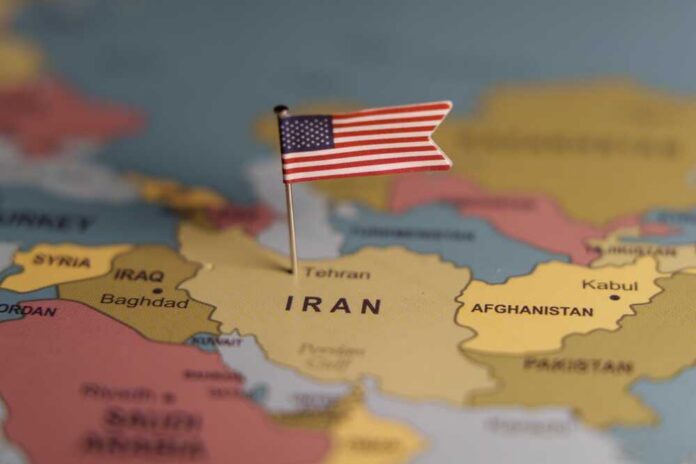
President Trump signed a 14-point ceasefire deal with Iran, but the hardest questions — nuclear weapons, missiles, and Iran’s proxy armies — are still unanswered.
Story Highlights
- Trump and Iranian President Masoud Pezeshkian digitally signed a Memorandum of Understanding (MOU) to halt the U.S.-Iran war that began February 28, 2026.
- The deal is interim — both sides have 60 days to negotiate a final agreement, with key nuclear issues left unresolved.
- Iran gets immediate oil export rights and eventual sanctions relief; the U.S. gets the Strait of Hormuz reopened toll-free for 60 days.
- Iran’s ballistic missile program and its network of regional proxy forces are not addressed anywhere in the deal.
What the Deal Actually Says
Trump signed the Memorandum of Understanding at a dinner at the Palace of Versailles during the G7 summit. The 14-point document calls for an “immediate and permanent cessation of military actions on all fronts, including Lebanon.” Iran can begin exporting oil the moment the MOU takes effect. The U.S. agrees to lift its naval blockade of Iranian ports within 30 days and eventually remove all sanctions — but only on a schedule tied to a final deal.
The Trump administration calls the arrangement “performance-based,” meaning Iran only gets the full benefits if it follows through. Sanctions relief is linked to compliance, and there is no set date for that relief to kick in. A senior U.S. official described the nuclear language as a “minimum standard.” Both sides also agreed to set up an oversight body to monitor the deal, and any final agreement must be approved through a binding United Nations Security Council resolution.
Big Problems Left on the Table
The MOU is explicitly an interim step. Both sides have 60 days to negotiate a “final deal,” which can be extended by mutual agreement. Iran’s nuclear program stays frozen in its current state during that window — but no enforcement rules have been decided yet. Iran promises not to develop or buy nuclear weapons, just as it did under the 2015 Joint Comprehensive Plan of Action (JCPOA). Critics note that promise came with no teeth then, and the new deal doesn’t yet spell out how it will be verified this time.
The framework also leaves out Iran’s ballistic missile program entirely. It does not address Iran’s support for proxy forces across the Middle East, including Hezbollah in Lebanon. Analysts at the Atlantic Council noted that “neither Iran’s missile program nor its network of regional partners is likely to be central to any near-term agreement.” Those gaps matter. Iran’s missiles and proxies have been major tools of regional destabilization for years, and walking away from the table without addressing them is a real concern for American security interests.
Israel Left in the Dark — and on the Hook
The deal caught Israeli Prime Minister Benjamin Netanyahu off guard. Axios reported that Netanyahu was not told in advance and had to reach out to allies close to the Trump administration to find out what was happening. The MOU demands that Israel withdraw its forces from southern Lebanon, where nearly 4,000 people have died and over one million have been displaced since March 2. Iran’s foreign ministry warned that any continued Israeli military action in Lebanon would be treated as a violation of the agreement.
#US #Iran agree on a 60-day roadmap; #USD supported despite light #Fedspeak; could #EURUSD bearish breakout persist? #USDJPY climbs as an intervention is missing; all eyes on #GBP and whether PM #Starmer steps down
Our daily commentary 👉https://t.co/i2Ch64JwGL
#XM pic.twitter.com/wJxIVnQNo8— XM Europe (@xmeurope) June 22, 2026
Israel’s response to the deal remains uncertain. Vice President JD Vance publicly warned Israel against opposing the U.S.-Iran agreement, a remarkable moment that signals real tension between Washington and its closest Middle East ally. The Strait of Hormuz, through which roughly 20% of the world’s oil flowed before the conflict, will reopen toll-free for 60 days under the deal. After that, Iran and Oman will negotiate the future management of that critical waterway — another major issue left unresolved for later talks.
A Pause, Not a Victory
Lawfare described the MOU plainly: it “will end the U.S.-Iran conflict without ending the war.” That framing fits the facts. The deal freezes the current situation while both sides try to work out the hard stuff later. Iran’s nuclear material is largely buried under rubble from U.S. strikes, which is why promising to “maintain the status quo” costs Tehran very little right now. The real test comes in the next 60 days, when negotiators must tackle enrichment limits, stockpile disposal, and verification — the issues that have derailed every prior Iran deal.
The $300 billion reconstruction fund for Iran is another eyebrow-raiser. The U.S. will not contribute directly, but the fund’s existence signals major economic relief for Tehran. Conservative critics and some Republicans have already pushed back hard on the arrangement. Whether Trump can convert this ceasefire framework into a durable, verifiable nuclear agreement — one that actually protects American and Israeli security — is the question that will define the legacy of this deal.
Sources:
[1] Web – YouGov Poll: 78% of Americans Want Iran War Ended Now
[2] Web – What’s in the deal between the US and Iran? – BBC
[3] Web – What’s in the Iran deal Trump says he’s ready to sign – Axios
[4] Web – Trump and Iran’s president sign initial deal to end war, open Strait …
[5] Web – US releases official agreement with Iran. Read the 14-point text | CNN
[6] Web – Read the 14 points of the agreement between Iran and the U.S.
[7] Web – 2025–2026 Iran–United States negotiations – Wikipedia
[8] Web – Full text of Trump’s framework agreement to end Iran war – NPR
[9] Web – President Trump signed the Iran Memorandum of Understanding …
[10] YouTube – Trump and Iran’s president digitally sign MOU with terms to end war
[11] Web – President Trump has said the text of his agreement to end the Iran …
[12] Web – Iran Update Special Report, June 16, 2026 | ISW
[13] Web – U.S. Must Prevent a Nuclear-Capable Iran – AIPAC
[14] Web – Policy Alert: Key Questions as U.S.-Iran Negotiations Progress
[15] YouTube – The MOU Ignites a Firestorm
[16] Web – STATEMENT: Iran MOU Confirms Iran War Was Failure of Historic …
[17] Web – The US–Iran memorandum of understanding nods to international …
[18] Web – Key points of the 2026 US-Iran Memorandum of Understanding
[19] Web – [PDF] June 17, 2026 The Honorable Marco Rubio Secretary of State U.S. …
[20] Web – Ceasefire Without End | Lawfare
[21] Web – 2026 Iran war ceasefire – Wikipedia
[22] Web – Experts react: The US and Iran just announced an interim peace …
[23] Web – The agreement between Iran and the US lays out the terms of the …
[24] YouTube – Iran, US reach deal to extend ceasefire, pending Trump’s approval
[25] Web – Walking a Tightrope: Scenarios for Iran–US Confrontation
[26] Web – The United States and Iran signed the 14-point interim ceasefire …
[27] Web – President Donald Trump has found an off‑ramp to the five‑week war …