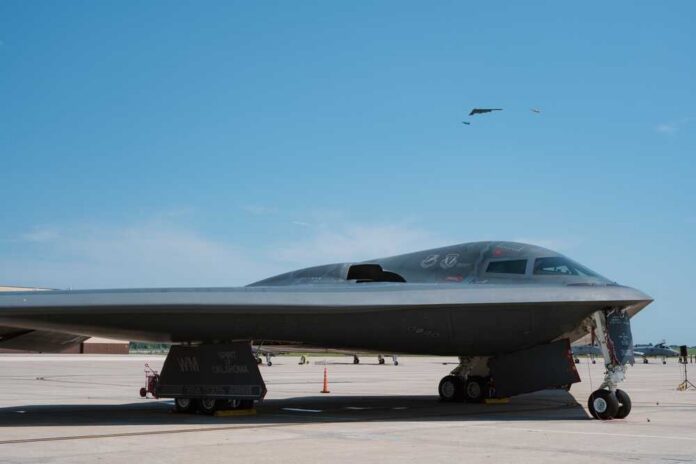
Chinese scientists claim to have uncovered critical flaws in America’s B-21 Raider stealth bomber, potentially handing Beijing a dangerous edge in the Pacific arms race under President Trump’s renewed focus on military strength.
Story Snapshot
- China’s CARDC researchers used PADJ-X simulations to identify aerodynamic and radar vulnerabilities in the B-21 Raider based on public images.
- A 2023 Chinese wargame simulated hypersonic AI missiles downing a B-21 and its drone through near-space communications and retasking.
- U.S. Air Force accelerates B-21 production toward 2027 fielding despite these claims, with a second test aircraft at Edwards AFB.
- Expert Harry J. Kazianis warns the claims merit serious U.S. attention, not dismissal, due to China’s rigorous science.
- Uncertainties persist as simulations rely on estimates of classified B-21 stealth features like RCS and electronic warfare.
Chinese Simulations Target B-21 Vulnerabilities
Researchers from China’s Aerodynamics Research and Development Centre (CARDC) employed the PADJ-X simulation tool to analyze the B-21 Raider’s design. They pinpointed aerodynamic weaknesses and elevated radar signatures from publicly available images and assumptions about flying-wing geometry. Thermal signatures from exhaust and blended inlets also emerged as detectible risks. These findings, detailed in March 2026 reports, challenge the bomber’s stealth supremacy designed to penetrate advanced defenses like China’s.
2023 Wargame Demonstrates Simulated Interception
Chinese researchers published a study in Acta Aeronautica et Astronautica Sinica in November 2023 simulating a wargame scenario. Hypersonic Mach-6 missiles with AI networking downed a B-21 and accompanying drone. Key enablers included solid-fuel pulse engines, retasking capabilities, and reliable near-space communications validated in 2022. The simulation highlighted how China’s global networks—ground, sea, satellite—could overcome stealth evasion tactics.
U.S. Response and Production Push
Northrop Grumman unveiled the B-21 Raider on December 2, 2022, at its Palmdale facility as a successor to the B-2 Spirit with refined stealth shaping and open-architecture for upgrades. The U.S. Air Force initiated low-rate production after a January 2024 contract. A second test aircraft reached Edwards AFB on September 11, 2025. President Trump’s administration eyes 2027 fielding to counter Pacific threats, straining budgets but prioritizing air superiority amid Chinese advances.
Expert Warnings on Strategic Risks
Harry J. Kazianis of 19FortyFive asserts the Chinese claims deserve scrutiny, rooted in peer-reviewed science rather than propaganda. He cautions that aerodynamic and thermal flaws could shift Pacific balances if real, urging upgrades beyond dismissal. Diverse views note simulations use incomplete public data, overestimating vulnerabilities, yet consensus affirms threats from China’s IRST, low-frequency radars like JY-27A, and AI processing.
Scientists In China Think They Have Found A B-21 Raider U.S. Air Force Stealth Bomber Flawhttps://t.co/JiZTBTcZUJ
— 19FortyFive (@19_forty_five) March 22, 2026
Implications for U.S. Deterrence
Short-term, these claims may prompt B-21 software and electronic warfare adjustments during testing. Long-term, erosion of stealth edges could force tactical changes, reshaping Indo-Pacific deterrence. China’s PLA gains confidence in anti-access/area-denial strategies, spurring global anti-stealth R&D. U.S. allies face airpower uncertainties, while political tensions escalate in the arms race. Uncertainties remain on classified B-21 capabilities versus simulation efficacy.
Sources:
B-21 Raider Stealth Bomber Problem? China’s ‘Mad …
China’s stealth design software PADJ-X finds potential …
China claims flaw in B-21 bomber