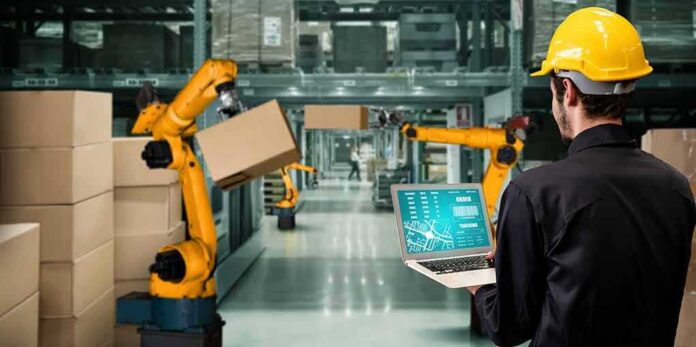
An artificial intelligence factory startup just raised $1.37 billion to reshape how America makes weapons at home.
Story Snapshot
- AI-driven manufacturer Hadrian raised about $1.37 billion at roughly an $8 billion valuation to expand U.S. defense production.
- The company says the money will fund new American factories, more research and development, and higher output for defense and aerospace systems.
- Hadrian already supplies the Pentagon and major contractors like Lockheed Martin and is pitching itself as a pillar of a modern defense industrial base.
- The raise highlights a deeper question many Americans share: will huge private bets on high-tech defense factories strengthen the country, or mainly enrich the same elites?
AI Factory Raises Big Money to Boost U.S. Defense Production
Artificial intelligence-powered manufacturing startup Hadrian announced a new $1.37 billion equity investment, one of the largest private rounds in the defense sector in recent years. Reporting from business outlets says the round values the company at about $7.9 to $7.87 billion, roughly four times its worth at the start of the year. Hadrian said the fresh capital will help it expand its manufacturing footprint inside the United States, grow research and development, and add production capacity for defense, aerospace, and industrial systems.
The funding comes from a mix of large investment firms, including WCM Investment Management, Washington Harbour Partners, Baillie Gifford, and J.P. Morgan’s Strategic Investment Group, among others. These investors are betting that future demand for weapons and advanced hardware will stay strong as global tensions grow. President Trump and Congress have pushed for faster production of munitions and ships, and the Pentagon is looking for new ways to make critical parts at home instead of depending on foreign factories. Hadrian is positioning itself as a key tool in that effort.
Hadrian’s Plan: More American Factories, Less Dependence on China
Hadrian describes itself as a “factory of the future,” using software, robotics, and artificial intelligence to run highly automated plants that make precision parts for rockets, satellites, jets, drones, and ships. Company statements say the mission is to “reindustrialize America” and help U.S. manufacturers compete head-to-head with China by producing domestically at globally competitive costs. With earlier funding rounds, including a $260 million Series C in 2025, Hadrian has already opened large sites in California and is building a 270,000-square-foot factory in Mesa, Arizona, focused on naval shipbuilding and other defense programs.
Public research on the company’s growth notes that Hadrian is moving from a single precision machining shop into a network of “software-defined” factories. These plants are designed to switch quickly between different parts while keeping quality high, something the older defense supply chain often struggles with. Hadrian also offers a “factories as a service” model, letting big contractors deploy its automation methods inside their own production lines. Supporters say this could make American workers more productive and shrink delivery times for critical hardware, addressing long-standing complaints from both conservatives and liberals about slow, wasteful government contracting.
Defense Tech Boom Raises Shared Questions About Power and Oversight
Hadrian’s latest raise fits a wider boom in defense technology funding, where private firms secure huge rounds well before full capacity is online. Supporters argue this is necessary because building advanced factories is extremely expensive and takes years, so investors must finance future production up front. Critics, including some industry analysts, worry that headlines about valuations and “saving American manufacturing” can overstate current output and understate how much of the benefit flows to wealthy venture capital funds and executives instead of ordinary citizens.
Defense-manufacturing startup Hadrian raised a $1.37B Series D at a $7.87B valuation — ~5x higher than a year ago — to build automated "Factories-as-a-Service" for U.S. defense & aerospace production.https://t.co/3Zcyy8gSTd
— 버섯돌이(Taehyun Kim) (@mushman1970) August 6, 2026
For many Americans on both the right and the left, this story touches familiar fears about a “deep state” or elite class that profits from endless military spending while the middle class struggles. On one hand, boosting domestic defense production can feel like a win: more jobs in factories, less dependence on foreign supply chains, and stronger national security. On the other hand, people remember past promises about globalization, clean energy, and tech revolutions that left communities hollowed out while corporate shareholders cashed in. Hadrian’s backers say their automated plants will create hundreds of new skilled jobs in places like Arizona and California, but independent reporting has not yet measured how many long-term, well-paid roles will result or how evenly they will be spread.
What This Means for Workers, Taxpayers, and the Defense Industrial Base
Hadrian’s rise also reflects frustration inside the military with slow, fragile supply chains. Traditional contractors often depend on small machine shops that take months or years to deliver parts, adding cost and delay to key programs. Hadrian claims its AI-powered factories can produce many components up to ten times faster and at lower cost, making it easier to keep stockpiles full and weapons ready. If those claims hold up in real-world programs, taxpayers could see savings and troops could get equipment more quickly.
Still, there are open questions. Public sources confirm the size of Hadrian’s funding and its stated plans to expand U.S. manufacturing, but they do not yet show detailed, independent data on how much new capacity is online, how many contracts are signed, or how much risk taxpayers carry through public-private deals. For citizens watching from the outside, the key issue is whether this new model of “AI factories plus venture capital” leads to a stronger, fairer industrial base that reflects American values, or simply deepens the pattern where powerful players in Washington and Wall Street decide the future while everyone else is told to trust them. This massive raise makes Hadrian a central test case in that debate.
Sources:
insidedefense.com, ctvnews.ca, therobotreport.com, cnbc.com, axios.com, wsj.com, linkedin.com, newmarketpitch.com, instagram.com