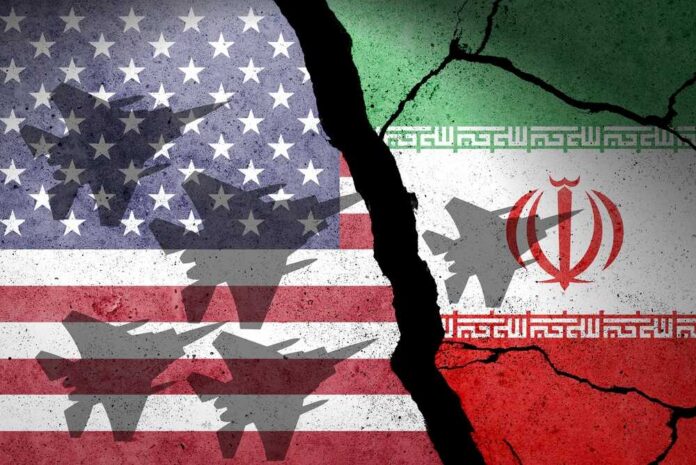
President Trump announced he called off a military strike on Iran scheduled for Tuesday — but made clear the weapons are still loaded and the clock is ticking.
Story Snapshot
- Trump publicly confirmed a military attack on Iran had been scheduled for Tuesday before he called it off, citing appeals from Gulf allies and what he described as “serious negotiations.”
- Qatar’s Emir, Saudi Crown Prince Mohammed bin Salman, and the United Arab Emirates President all reportedly intervened to request the pause.
- Trump posted a two-week suspension of strikes on Truth Social but simultaneously warned Iran faces “annihilation” if a deal is not reached quickly.
- The stock market added roughly $500 billion in value within 50 minutes of the announcement, reflecting how closely financial markets are tracking the conflict.
A Strike Scheduled — Then Stood Down
Trump stated publicly that a U.S. military attack on Iran had been set for Tuesday and that he personally ordered it halted. [1] According to Trump’s own account, Qatar’s Emir Sheikh Tamim bin Hamad Al Thani, Saudi Crown Prince Mohammed bin Salman, and United Arab Emirates President Mohamed bin Zayed Al Nahyan each reached out to request a pause. [1] Trump framed the decision as a response to diplomatic pressure from key Gulf partners rather than a change in overall strategy toward Tehran.
Trump also pointed to Iran’s cancellation of scheduled executions as a factor that, in his words, “had a big impact” on his decision not to strike at that moment. [3] Separately, he posted on Truth Social that the United States would suspend “bombing and attacks on Iran” for two weeks while negotiations proceed. [2] The administration described the pause as conditional — not a withdrawal of the military option — and ordered Defense Secretary Pete Hegseth and senior military commanders to remain in a state of readiness. [7]
Coercive Bargaining or Genuine De-escalation?
Skeptics argue the pause is tactical rather than a true stand-down. Trump’s own public statements support that reading. He warned Iran it can “make a deal or get annihilated” and that “there won’t be anything left of them” if Tehran does not move quickly. [7] That language is consistent with a strategy of maximum pressure — using the credible threat of force to extract concessions — rather than a genuine retreat from military confrontation. The two-week window functions as a deadline, not a ceasefire. [6]
This pattern is not new. Across decades of United States–Iran tensions, Washington has repeatedly paired military threats with diplomatic pauses to shape bargaining leverage and domestic opinion simultaneously. [5] The most consequential decisions in these standoffs are typically classified, while the public signals — statements, social media posts, press briefings — are themselves tools of coercion designed to pressure Tehran while reassuring allies. What looks like de-escalation from the outside may simply be the next move in a long-running pressure campaign.
What It Means for Americans at Home
The immediate market reaction was striking. U.S. stock markets gained roughly $500 billion in value within 50 minutes of Trump’s announcement, underscoring how directly the threat of a wider Middle East war has been weighing on the economy. [10] For ordinary Americans already dealing with elevated prices and economic uncertainty, the prospect of a conflict that could disrupt global oil flows through the Strait of Hormuz — one of the world’s most critical energy chokepoints — carries real consequences at the gas pump and beyond.
President Trump said Monday that he's called off a U.S. attack on Iran that had been "scheduled" for Tuesday, after the United States' Gulf partners requested it to allow for continued negotiations. https://t.co/XPiDoRnvb5
— CBS News (@CBSNews) May 18, 2026
A new poll cited in coverage of the conflict shows Americans are beginning to feel the costs of the Iran confrontation, even before any large-scale strikes have landed. [10] Whether Trump’s two-week pause produces a negotiated outcome or simply resets the countdown to a military strike remains the central question. Both sides of the political divide have reason to watch closely: conservatives who want maximum pressure to work without a costly war, and liberals concerned about the human and economic toll of yet another Middle East conflict. The next two weeks will test whether this is diplomacy or theater.
Sources:
[1] YouTube – Trump halts planned Iran attack after Gulf leaders intervene amid …
[2] YouTube – Trump says US to ‘suspend bombing and attack of Iran’ for two weeks
[3] Web – Trump says Iranian cancellation of executions ‘had big impact’ on …
[5] Web – Iran–United States relations during the first Trump administration
[6] Web – Trump Announces Two-Week Halt to Iran Strikes Amid Push for …
[7] Web – Trump warns of “critical period” in Iran war, threatening severe …
[10] YouTube – New poll shows Americans are feeling the costs of Iran war as …